
What Is AI Arbitrage? The Profitable Truth You Need to Know 2026
Introduction
You have probably heard someone online claim they are making thousands of dollars using AI tools they did not build themselves. No coding. No huge investment. Just a gap between what AI can produce and what people are willing to pay for it.
That gap has a name: AI arbitrage.
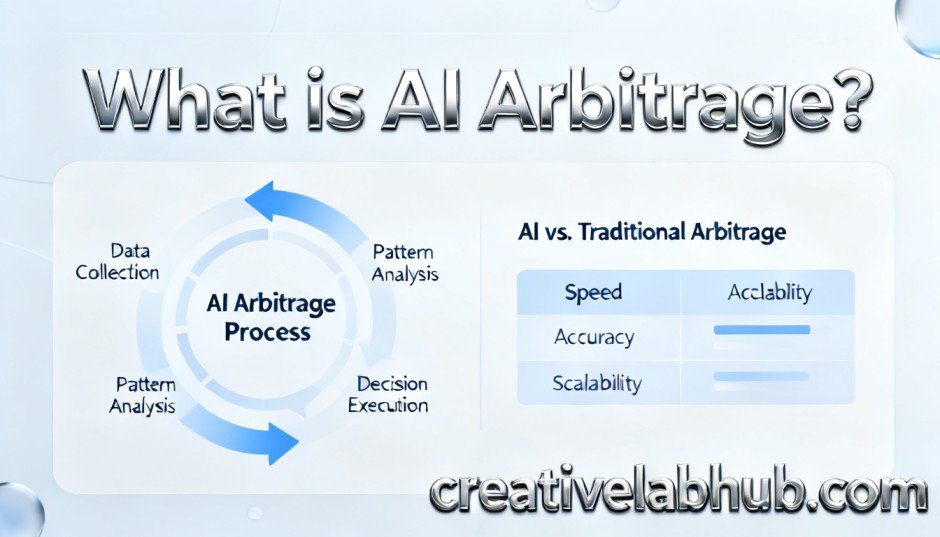
AI arbitrage is the practice of using artificial intelligence tools to produce value at a low cost, then selling or delivering that value to someone else at a higher price. The profit lives in the difference between your cost (mostly time and a few dollars per month for software) and what the market pays for the output.
It sounds simple because it is. But like any real opportunity, the details matter. This article walks you through exactly what AI arbitrage is, how it works, which models people use to make money, what the risks are, and how you can start in a structured, honest way.
No hype. Just a clear picture of what this actually looks like in 2026.
How AI Arbitrage Works: The Simple Breakdown
Traditional arbitrage is a concept that has existed in finance for decades. A trader buys an asset in one market where it is cheap, then sells it in another where the price is higher. The spread is the profit.
AI arbitrage follows the same logic, but the “asset” is output: content, design, code, analysis, video scripts, customer service, translation, data summaries, and more.
Core ConceptYou access AI tools that produce high-quality output quickly and cheaply. You sell that output to clients or audiences who either cannot use those tools themselves or simply value the finished result.
The Three-Part Formula
Every successful AI arbitrage operation runs on three elements:
- Access to an AI tool that produces the output (writing, images, code, voice, video, data analysis).
- A market or client who values that output and will pay for it.
- A gap between your cost and their price wide enough to make it worth your time.
The real skill is not using the AI itself. Most tools are accessible to anyone. The real skill is in identifying where the gap exists, understanding what a specific buyer wants, and packaging the output in a way that solves their actual problem.
“The AI is the factory. You are the entrepreneur who decides what to make and who to sell it to.”
$184BGlobal AI market size in 2024 (Grand View Research)
78%Of businesses plan to increase AI tool spending through 2026
10xSpeed advantage AI gives creators vs. traditional production
The Most Common AI Arbitrage Models Right Now
There is no single way to do this. People use AI arbitrage across a surprising range of industries and niches. Here are the models that have proven to work in 2026.
1. Content Creation and Reselling
This is the most common entry point. You use AI writing tools to produce articles, blog posts, newsletters, social media captions, email sequences, or product descriptions. You then sell those to businesses, content agencies, or directly on freelance platforms.
Many small business owners need content regularly but do not have the time or skill to write it. They do not care that you used AI. They care that the content is clear, accurate, and on-brand. Your job is to ensure it is.
2. AI Design and Visual Production
Graphic design used to require years of training. AI image and design tools have changed that. You can now produce logos, social media graphics, product mockups, and even short animations at a fraction of the time traditional design requires.
Platforms like Fiverr and Etsy have thousands of sellers offering AI-assisted design services. The arbitrage is between the AI’s production speed and the client’s perceived value of professional-looking visuals.
3. AI-Assisted Coding and App Prototypes
Developers who use AI coding assistants can complete projects in a fraction of the usual time. Some non-developers use AI tools to build basic applications, scripts, or automations, then charge clients for those deliverables.
This model carries more quality risk. But if you understand the problem well and can validate the output, it works. Clients who need a simple landing page or a data scraper do not always need a senior engineer. They need something that functions.
4. Faceless YouTube and Video Channels
AI tools can generate voiceovers, scripts, stock video sequences, and even animated explainers. Some creators build entire YouTube channels using these tools, earning through ad revenue, sponsorships, or affiliated product sales. The channel exists. The content is real. The cost of production is very low.
5. AI Newsletters and Information Products
Curated newsletters have real value. If you use AI to help research, summarize, and format a niche newsletter, you can charge subscribers or monetize through sponsorships. The AI handles the heavy lifting. You provide the curation, judgment, and voice.
6. AI-Powered Services Sold as Agencies
Some entrepreneurs build what they call “AI agencies.” They offer SEO content, ad copy, customer service chatbot setups, or social media management. The backend is AI-powered. The client experience is professional and human. The margin is wide.
| Model | Startup Cost | Skill Required | Income Potential |
|---|---|---|---|
| Content writing services | Low ($20–$50/mo) | Writing judgment, editing | $500–$5,000/mo |
| AI design services | Low ($30–$80/mo) | Aesthetic sense, client briefs | $300–$3,000/mo |
| AI coding assistance | Medium ($50–$100/mo) | Basic technical understanding | $1,000–$8,000/mo |
| Faceless YouTube | Low-Medium | Video strategy, consistency | $200–$10,000/mo |
| AI newsletter | Very Low | Niche knowledge, writing | $200–$5,000/mo |
| AI agency | Medium | Sales, project management | $2,000–$20,000/mo |

Tools People Use for AI Arbitrage
What is ai arbitrage The tools you use depend on the model you choose. Here is a practical overview of what most people in this space actually rely on.
Writing and Content Tools
- Claude, ChatGPT, Gemini: Long-form writing, research summaries, email sequences, scripts.
- Jasper, Copy.ai: Structured marketing copy, ad text, landing pages.
- Notion AI, Writesonic: Blog posts and content calendars at scale.
Design and Visual Tools
- Midjourney, Adobe Firefly, DALL-E: Image generation for marketing, products, and social content.
- Canva AI: Ready-made design templates powered by AI for non-designers.
- Runway ML: Short AI-generated video clips and animations.
Automation and Workflow
- Zapier, Make: Automate repetitive tasks so you can deliver at scale.
- ElevenLabs: Realistic AI voiceovers for videos and podcasts.
- Descript: AI-powered audio and video editing.
Pro TipYou do not need every tool. Start with one AI tool that matches your chosen model. Master it first. Then add tools only when a specific gap in your workflow demands it.
Real Risks You Should Not Ignore
AI arbitrage is not a passive income button. There are genuine risks, and most people who fail do so because they skipped this part.
Quality Control Is Your Responsibility
AI makes mistakes. It produces confident-sounding misinformation. It sometimes generates generic, forgettable output. If you sell that to a client without reviewing it, you damage your reputation and their business. You are always the editor, the quality check, and the final judgment call.
Market Saturation in Some Niches
Everyone with an internet connection now has access to the same AI tools. Some freelance categories, especially basic AI-written articles, have seen prices drop significantly. You need to specialize, add genuine expertise, or serve niches where quality still commands a premium.
Legal and Ethical Grey Areas
Copyright law around AI-generated content is still evolving. Selling AI-generated work without disclosing it can violate platform terms of service or client expectations. Be transparent with your clients about your process. Protect yourself with clear contracts.
Watch OutSome platforms explicitly prohibit selling AI-generated content. Read the terms of service before listing services on any marketplace. Violating them can get your account permanently banned.
Dependency on Third-Party Tools
Your business relies on tools you do not control. Pricing changes, API restrictions, or a tool shutting down can disrupt your operation overnight. Diversify your toolkit and never build a business around a single point of failure.
The Race to the Bottom
If your only edge is using AI to produce content faster and cheaper, you will eventually face someone willing to do it for less. Your long-term moat has to be something harder to copy: domain expertise, a strong client relationship, a personal brand, or a systemized process that delivers consistently at a level others cannot match.
How to Start AI Arbitrage in 5 Steps
If you want to try this seriously, here is a practical path that avoids the most common early mistakes.
- Choose one model that matches a skill you already have.If you write well, start with content services. If you have design instincts, start there. Your existing knowledge is the quality filter that makes AI output worth paying for.
- Identify a specific audience or niche.Do not try to serve everyone. Pick a niche: real estate agents who need social media content, SaaS startups who need onboarding emails, local businesses who need website copy. Specificity makes you easier to hire.
- Build a small portfolio before you pitch anything.Produce three to five samples using your chosen AI tools. Apply your own editing and judgment. Make sure the work genuinely reflects value, not just speed.
- Price based on value, not on your time cost.The price a client pays has nothing to do with how long it took you to produce the output. It reflects the value they receive. Research what established freelancers in your niche charge. Start slightly below market rate to build initial proof, then raise prices as you accumulate results.
- Deliver, ask for feedback, and improve your process.The first few projects will reveal the gaps in your workflow. Fix them. Build systems for the parts that repeat. As your process tightens, your margin grows without sacrificing quality.
Is AI Arbitrage Still Profitable in 2026?
This is the question everyone asks. The honest answer is: yes, but the window is narrowing for low-effort plays.
In 2022 and 2023, simply generating AI content and selling it was a novelty advantage. Clients did not know what AI could do. Buyers on content marketplaces did not understand why some providers were so fast and cheap. That edge has largely disappeared.
What still works in 2026 is AI arbitrage layered with genuine expertise. A freelancer who understands SEO strategy and uses AI to scale production is not replaceable by someone who just has the AI tool. A designer who uses AI to iterate faster but brings real taste and brand understanding to the work commands real rates.
Where the Real Opportunity Sits in 2026The most profitable AI arbitrage today happens at the intersection of a specialized domain (legal, medical, finance, real estate, software) and AI-powered production. The AI reduces the cost. The specialization maintains the premium.
According to McKinsey’s 2025 State of AI report, companies are increasingly paying more for specialized AI-assisted output, not less. The market is bifurcating: commodity content prices are falling while expert-level AI-augmented services are rising in value.
If you position yourself in the expert lane, AI arbitrage is not just viable. It is one of the most scalable solo business models available right now.
Final Thoughts
AI arbitrage is not a loophole. It is a business model. Like any business, it rewards people who add real value, understand their market, and build systems that scale.
The opportunity comes from a very real gap: AI tools can now produce outputs that took significant time or money to create before. Most buyers do not use these tools themselves. Some are too busy. Some do not know how. Some simply want the finished result, not the process.
You bridge that gap. You use the tools skillfully. You apply judgment that makes the output genuinely useful. You build a reputation for delivering work that solves real problems.
That is what AI arbitrage actually is. Not a shortcut. A skill set built on top of powerful new tools.
Now, which model fits your existing skills best? That is the only question worth answering before you start.
Frequently Asked Questions
Is AI arbitrage legal?▾How much money can you realistically make with AI arbitrage?▾Do I need to tell clients I used AI?▾What is the difference between AI arbitrage and prompt engineering?▾Which AI arbitrage model is best for beginners?▾Can AI arbitrage replace a full-time job?▾Is AI arbitrage the same as dropshipping?▾What skills do I actually need to start?▾Will AI eventually eliminate the arbitrage gap?▾Where can I find clients for AI arbitrage services?▾
James Carter
AI Business Strategist & Content Writer
James Carter is a digital entrepreneur and AI tools educator with over seven years of experience in freelancing, content strategy, and online business. He writes about practical ways individuals and small businesses can use AI to build income and scale their work without massive budgets or technical backgrounds.
Also read creativelabhub.com
Email: johanharwen314@gmail.com
Author Name: Johan Harwen