

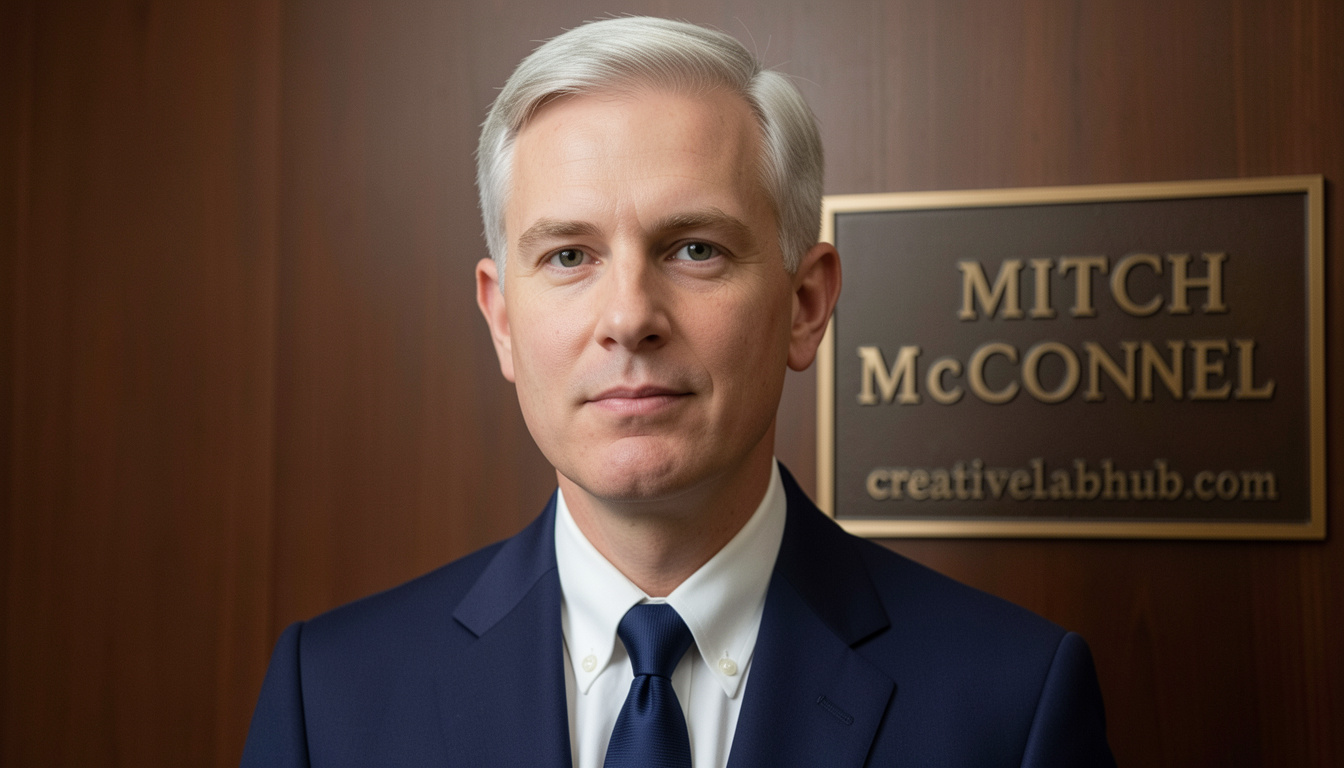
Young Mitch McConnell: The Untold Rise of a Ruthless Political Strategist in 2026
Introduction
You probably know Mitch McConnell as the stone-faced Senate leader who shaped American politics for decades. But do you know where it all started?
The story of young Mitch McConnell is one of the most underrated political origin stories in American history. Before the power, the filibusters, and the Supreme Court battles, there was a nerdy kid from Louisville who wore an “I Like Ike” button in fifth grade. A kid who overcame polio before he could even ride a bike properly. A kid who had a plan long before most teenagers had a clue.
In this article, you will learn exactly how young Mitch McConnell grew from a sickly child in Alabama into one of Washington’s most calculated political minds. We cover his childhood struggles, his college years, his first political offices, and the exact moment he became impossible to ignore. Whether you admire him or despise him, his early story is genuinely fascinating.
Born Into Challenges: McConnell’s Alabama Roots
Addison Mitchell McConnell Jr. was born on February 20, 1942, in Sheffield (also cited as Tuscumbia), Alabama. His father, Addison Mitchell McConnell Sr., served as an Army officer during World War II. His mother, Julia “Dean” Shockley McConnell, kept the household together while his father was away.
The family did not have it easy.
<When McConnell was around two years old, he contracted polio. The disease weakened part of his leg and required years of intensive therapy and rehabilitation. His family spent significant money on his medical care and daily exercises to restore his mobility.> Those early years were defined by physical struggle and quiet determination.
Here is what makes this part of the story remarkable. <His family’s investment in his recovery worked. Over time, he regained sufficient function in his leg, though walking for long periods occasionally remained difficult.> He did not let it define him. He let it sharpen him.
The lesson he learned early was simple: persistence matters more than circumstances.

The Move to Louisville: Where Politics First Clicked
<When McConnell was thirteen, his family relocated to Louisville, Kentucky.> That move changed everything. Louisville gave young Mitch McConnell a stage. And he wasted no time climbing onto it.
He enrolled in a local high school and quickly showed his political instincts. <He wore an “I Like Ike” button in his fifth grade picture and sat in front of the television to watch both political conventions in full in 1956.> While other kids were playing outside, he was studying political theater.
His junior year of high school, he decided to run for student council president. This was not a simple task for a self-described nerdy kid without much natural charisma. But even then, he was a pragmatist. <He sought out the endorsements of the most popular students in school, including Pete Dudgeon, an all-city football player, and Janet Boyd, a well-known cheerleader.> He used flattery. He built a network. He campaigned strategically.
He won.
It sounds small. But that high school campaign was a perfect preview of every race he would run for the next fifty years.
University Years: Building the Political Foundation
After high school, young Mitch McConnell pursued higher education with the same focused intensity. He enrolled at the University of Louisville College of Arts and Sciences, where he studied political science.
Once again, he ran for office. <He became student body president at the University of Louisville and graduated with honors in 1964.> If you see a pattern here, you are paying attention.
He then moved on to the University of Kentucky College of Law, where he continued building his resume. <At the University of Kentucky, he was elected president of the Student Bar Association and earned his law degree in 1967.> Three different institutions. Three elected offices. Zero coincidences.
His college years were not just about degrees. They were a rehearsal. Every campaign, every coalition, every negotiation taught him something he would later deploy in the United States Senate.
During this same period, he also served briefly in the Army Reserve, though his active service was cut short by a medical separation. He returned to civilian life ready to enter the world of politics professionally.
Washington Apprenticeship: Learning From the Best
After law school, the young McConnell did what every smart aspiring politician does. He went to Washington and watched how it worked from the inside.
<He interned and assisted prominent Kentucky Republicans, including Senator John Sherman Cooper, before later serving as a legislative assistant to Senator Marlow Cook in the late 1960s.> These were formative years. He learned how the Senate operated. He studied the levers of power up close.
<From 1968 to 1970, McConnell worked as a legislative assistant to U.S. Senator Marlow Cook.> He absorbed everything. He watched how senior senators built alliances, blocked opponents, and moved legislation. He was not famous yet. But he was learning.
Then came a significant boost to his career. <He served as Deputy Assistant U.S. Attorney General under President Gerald Ford from 1974 to 1975.> This role gave him federal credibility and a national network. He was no longer just a Kentucky kid with ambitions. He was a Washington insider with a plan.
The First Real Office: Jefferson County Judge Executive
Now comes the chapter that most people skip entirely when they talk about young Mitch McConnell. This is where it gets genuinely interesting.
<In 1977, McConnell was elected Jefferson County Judge/Executive, the top political office in Jefferson County, Kentucky, defeating incumbent Democrat Todd Hollenbach III by 53% to 47%.> This was a significant upset. Jefferson County was heavily Democratic at the time. Winning there as a Republican required creativity, coalition-building, and a willingness to say what people wanted to hear.
His strategy? Court the unions.
<McConnell sought and obtained labor endorsements, which helped him win the county judge race by approximately 11,000 votes.> The unions believed he supported collective bargaining rights for public employees. They backed him hard.
Here is the twist. After he won, his position on collective bargaining quietly changed. Union leaders felt deceived. <One political biography of McConnell noted that pandering to the unions was one of the few things in his public career to which he openly admitted feeling ashamed.> McConnell himself later disputed the characterization, insisting he never made a firm promise.
This episode is often cited as an early example of the pragmatic, win-at-all-costs approach that would define his career. Right or wrong, it worked. He won.
<McConnell was re-elected as county judge executive in 1981, defeating Jefferson County Commissioner Jim “Pop” Malone 51% to 47%, outspending his opponent three to one.> He held the office until 1984. During his time as judge executive, <he supported collective bargaining rights for public employees and steered federal funds toward the expansion of Jefferson Memorial Forest.>
At this stage in his life, he was considered a moderate Republican. Not the hardline conservative most people associate with him today. That evolution came later.
The 1984 Senate Campaign: The Upset That Changed Everything
By 1984, young Mitch McConnell had spent years preparing for one moment. That moment was his 1984 Senate campaign against sitting Democratic Senator Walter “Dee” Huddleston.
Nobody thought he could win. <In August of 1984, McConnell’s campaign team was 40 points down in the polls.> His own campaign manager later admitted she was not packing her bags for Washington. The odds were brutal.
But McConnell understood something that most people missed. Campaigns are not won on charisma. They are won on strategy.
His team ran one of the most creative political ad campaigns of the era. The famous “hound dogs” television ad mocked Huddleston for missing Senate votes while collecting speaking fees. It was clever, it was memorable, and it worked.
The result shocked the entire country. <McConnell defeated incumbent Democrat Walter Huddleston in a narrow victory, making him the first Republican to win a Senate seat in Kentucky since 1968 and the only Republican challenger in the country to defeat an incumbent Democratic senator that year.>
Think about that for a second. Forty points down. Five months later, he was headed to Washington.
What Made Young McConnell Different From Other Politicians
People often wonder how a politician with no remarkable charisma or speaking ability climbed so high. The answer is hiding in plain sight throughout his early years.
Here are the qualities that set young Mitch McConnell apart from his peers:
- He was a planner. From high school to the Senate, every career move was calculated. He never stumbled into success.
- He was patient. He spent years learning from others before asking voters for their trust.
- He was disciplined. He never got distracted. His focus stayed on politics from childhood to adulthood without wavering.
- He was pragmatic. He did what winning required, even when it made him unpopular.
- He studied power. He did not just want to hold office. He wanted to understand how power actually works and then use it.
<His first significant political role came when he managed Senator Marlow Cook’s campaign in 1968, a pivotal moment that cemented his commitment to public life.> From that point forward, he was all in.
The Personal Side of Young McConnell
Politics was not his entire life during these years, even if it felt that way.
<McConnell married Sherrill Redmon in 1968. They had three daughters together, named Elly, Porter, and Claire. The marriage ended in divorce in 1980.> He later married Elaine Chao in 1993, who would go on to serve as Secretary of Labor and Secretary of Transportation in two separate administrations.
His personal life during his young adult years was relatively private. He was not known for wild socializing or headline-grabbing controversies. He was known for working. He kept his head down, built his network, and executed his plans.
One thing that people who knew him during this period often noted was his consistency. He was the same person in private that he presented in public. Serious, methodical, and always thinking three steps ahead.
The Legacy of McConnell’s Early Years
Understanding young Mitch McConnell gives you a completely different lens for everything that came after.
The Senate obstruction tactics? You can trace them back to a high school kid who figured out that winning requires building coalitions, not just making speeches.
The judicial strategy that placed hundreds of conservative judges on federal courts? It connects back to the young attorney who spent years learning how Washington really works.
The iron discipline he showed for decades in the Senate? It starts with a two-year-old in Alabama refusing to let polio stop him.
<McConnell began his career as an elected official as county judge executive of Kentucky’s Jefferson County in 1977 and was elected to the U.S. Senate as a moderate Republican in 1984.> From there, the rest is American political history.
His early years reveal something important. The most powerful politicians are rarely the most talented or the most charismatic. They are the ones who started planning earlier, worked harder, and understood that politics is a long game.
Conclusion: The Origin Story That Explains Everything
The story of young Mitch McConnell is not just interesting historical trivia. It is the explanation for one of the most consequential political careers in modern American history.
You now know how a polio survivor from a small Alabama town built himself into the most powerful senator of his generation. You know about the high school campaigns, the Washington internships, the county courthouse victories, and the 40-point comeback that launched everything.
His rise was not accidental. It was engineered, step by step, from childhood. Whether you view that as admirable or alarming probably depends on your politics. But the story itself is undeniable.
What do you think shapes a politician more: the hardships they face early in life, or the opportunities they create for themselves later? Drop your thoughts in the comments. And if you found this breakdown useful, share it with someone who thinks they already know everything about Mitch McConnell.

Frequently Asked Questions
1. Where was Mitch McConnell born? Mitch McConnell was born on February 20, 1942, in Sheffield (also recorded as Tuscumbia), Alabama. His family later moved to Louisville, Kentucky, when he was thirteen years old.
2. Did young Mitch McConnell really have polio? Yes. McConnell contracted polio around the age of two. It weakened part of his leg and required years of intensive physical therapy. He eventually recovered sufficient function and went on to a highly active political career.
3. What did Mitch McConnell study in college? He studied political science at the University of Louisville, graduating with honors in 1964. He then earned his law degree from the University of Kentucky College of Law in 1967.
4. What was Mitch McConnell’s first elected office? His first elected office was Jefferson County Judge/Executive in Kentucky, a position he won in 1977. He held the office until 1984, when he won his first Senate race.
5. Was young Mitch McConnell a moderate Republican? Yes. Early in his career, McConnell was considered a moderate Republican. He supported some labor-friendly positions and steered federal funds toward public projects. His political positions became significantly more conservative as his career progressed.
6. How did McConnell win his first Senate race in 1984? He defeated incumbent Democratic Senator Walter Huddleston despite being 40 points behind in the polls. A creative television ad campaign mocking Huddleston for missing votes helped swing public opinion. He won as the only Republican challenger in the country to defeat an incumbent Democratic senator that year.
7. Who did young McConnell work for in Washington before running for office? He worked as a legislative assistant to Senator Marlow Cook from 1968 to 1970, and later served as Deputy Assistant U.S. Attorney General under President Gerald Ford from 1974 to 1975.
8. Did McConnell always want to be a politician? By all accounts, yes. He wore political campaign buttons as a child, watched full political conventions on television as a fifth grader, and ran for student government in high school, college, and law school. Politics was never a detour for him. It was always the destination.
9. What is Mitch McConnell’s full name? His full legal name is Addison Mitchell McConnell Jr. He is commonly known as Mitch McConnell.
10. What was the “hound dogs” ad in the 1984 campaign? It was a famous and highly effective television advertisement run during McConnell’s 1984 Senate campaign. The ad used the image of hound dogs tracking down Senator Huddleston to mock him for missing Senate votes while collecting paid speaking fees. It became one of the most memorable political ads of that election cycle.
also read: creativelabhub.com
email: johanharwen@314gmail.com
Author Name: Jordan T. Caldwell
About the Author : Jordan T. Caldwell is a political journalist and content strategist with over a decade of experience writing about American government, Senate leadership, and political history. He holds a degree in Political Science and has contributed to multiple digital publications covering U.S. domestic policy. Jordan is passionate about making political history accessible to everyday readers through clear, engaging storytelling.
