

Construction Site Secrets: The Surprisingly Powerful Guide to Understanding How They Work 2026
Introduction
Every time you walk past a construction site, there’s a whole world operating behind that hoarding. Cranes swinging overhead. Workers in hard hats moving with purpose. Concrete mixers turning. Machines beeping. It looks chaotic from the outside — but inside, a construction site is one of the most carefully coordinated environments you’ll ever encounter.
A construction site is where ideas on paper become physical reality. It’s where architects’ drawings meet engineers’ calculations, and where hundreds of skilled people work together to raise something from the ground up. Whether it’s a single-family home or a fifty-floor skyscraper, the principles running a construction site are remarkably consistent.
This article covers everything you need to understand about a construction site. We’ll walk through how sites are set up, how they’re managed, what safety looks like on the ground, what equipment does what, and what the biggest challenges are. By the end, you’ll see a construction site completely differently — not as a noisy inconvenience, but as an extraordinary human achievement in motion.
What Is a Construction Site and How Is It Set Up?
A construction site is any location where building, infrastructure, or civil engineering work is actively taking place. That includes residential builds, commercial developments, road projects, bridges, tunnels, and everything in between.
Before a single brick is laid, setting up a construction site involves serious planning. The site needs to be secured, organized, and equipped before work begins. This setup phase is called site establishment, and it’s more complex than most people realize.
Site Boundaries and Security
Every construction site starts with a clearly defined perimeter. Hoarding — the solid barriers you see around urban builds — serves multiple purposes. It keeps unauthorized people out. It contains noise and debris. It protects the public from falling objects and active machinery.
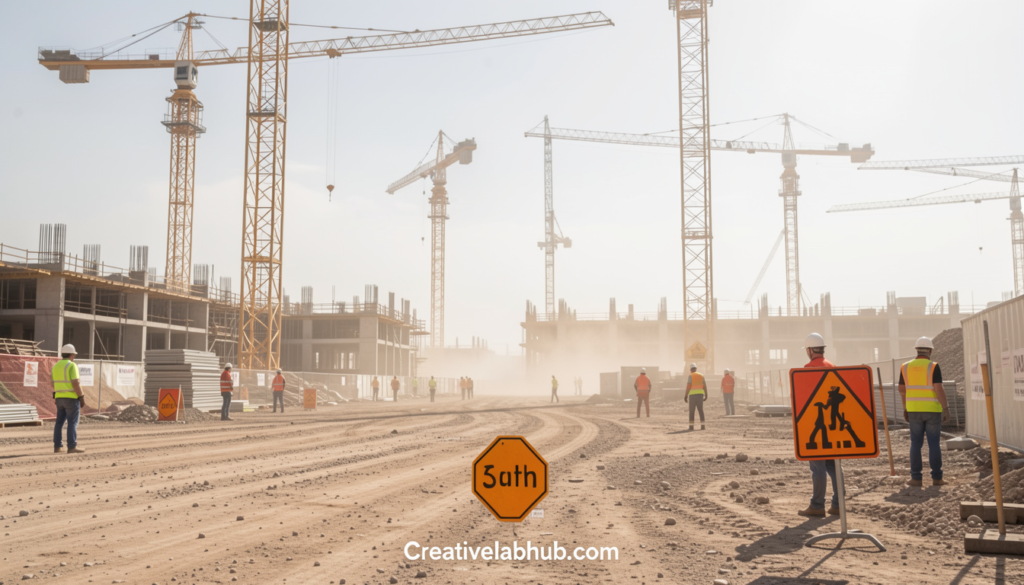
Security on a construction site is serious business. Unauthorized access is dangerous and costly. Most sites use a combination of perimeter fencing, security cameras, access control systems, and on-site security personnel. Equipment theft from construction sites costs the UK alone an estimated £800 million per year, according to industry data, which tells you just how important site security is.
Site Offices and Welfare Facilities
Every functioning construction site needs on-site infrastructure for the workers who run it. Site offices — usually temporary modular buildings — house the project management team, drawings, contracts, and communications equipment. Welfare facilities include canteens, toilets, washing facilities, and rest areas.
These might seem like minor details, but they’re legally required in most countries. Adequate welfare facilities on a construction site directly affect worker morale, productivity, and retention. I’ve seen firsthand how a well-organized site office changes the entire atmosphere of a project.
Construction Site Safety: The Rules That Keep Everyone Alive
Safety is the single most critical dimension of any construction site. The construction industry consistently ranks among the most dangerous in the world. In the United States, construction accounts for roughly 20% of all worker fatalities annually, despite employing a fraction of the total workforce.
That’s a sobering number. But it’s also why construction site safety is so heavily regulated, rigorously enforced, and constantly evolving.
Personal Protective Equipment (PPE)
Step onto any legitimate construction site and you’ll see PPE everywhere. It’s not optional. The standard minimum PPE on a construction site includes:
- Hard hat — protects against falling objects and head impacts
- High-visibility vest — ensures workers are visible to machinery operators
- Steel-toed boots — protects feet from heavy drops and punctures
- Safety glasses — shields eyes from dust, debris, and sparks
- Gloves — protection against cuts, chemicals, and abrasion
- Ear protection — required in high-noise zones
Depending on the task, additional PPE like respirators, harnesses, and face shields may be required. No PPE, no entry — it’s that simple on a well-run construction site.
Construction Site Safety Regulations
In most countries, construction site safety is governed by strict regulations. In the UK, the Construction (Design and Management) Regulations — known as CDM — set out legal duties for everyone involved in a construction project, from client to contractor. In the US, OSHA sets federal standards that all construction sites must meet.
Regular safety briefings — often called toolbox talks — are a core part of daily life on a construction site. These short sessions cover specific risks for that day’s work. They keep safety front of mind and give workers a chance to raise concerns.
The Most Common Hazards on a Construction Site
Understanding the hazards is the first step to managing them. The most frequently cited dangers on a construction site include:
- Falls from height — the leading cause of construction fatalities worldwide
- Struck by objects — falling tools, materials, and equipment
- Electrocution — contact with live wires during excavation or installation
- Caught in or between — machinery entrapment and trench collapses
- Manual handling injuries — repetitive strain and acute injuries from heavy lifting
Good construction site management addresses all of these through risk assessments, method statements, and physical control measures like edge protection, signage, and machinery guards.
Construction Site Management: Who Does What?
A construction site doesn’t run itself. Behind every smooth-running project is a carefully structured team with clearly defined roles. Understanding who does what helps you appreciate just how much human coordination goes into every build.
The Project Manager
The project manager sits at the top of the site hierarchy. They own the overall programme, the budget, and the relationship with the client. A good project manager on a construction site is part strategist, part diplomat, and part crisis manager. They track progress against programme, manage risk, and make decisions that keep things moving when problems arise.
The Site Manager and Foreman
The site manager — sometimes called the site agent — translates the project manager’s plans into daily reality on the construction site. They coordinate subcontractors, manage deliveries, run daily briefings, and handle the constant flow of practical problems that arise on any active build. The foreman sits one level below, directly supervising specific trades or sections of the site.
Subcontractors and Trades
The actual building work on a construction site is usually carried out by specialist subcontractors. A main contractor rarely employs every trade directly. Instead, they coordinate a network of subcontractors covering:
- Groundworks and foundations
- Structural steel and concrete
- Mechanical, electrical, and plumbing (MEP)
- Carpentry and joinery
- Plastering and drylining
- Roofing and cladding
- Finishing trades
Managing multiple subcontractors on a construction site simultaneously is one of the biggest logistical challenges in the industry. Sequencing their work correctly — so that each trade can do their job without blocking another — requires careful planning and constant communication.
The Health and Safety Manager
On larger construction sites, a dedicated health and safety manager oversees all safety compliance. They conduct inspections, investigate incidents, maintain safety records, and ensure the site remains compliant with all relevant regulations. Their role is increasingly seen not just as a legal necessity but as a genuine driver of productivity — safe sites lose less time to accidents and disputes.
Construction Site Equipment: What All Those Machines Actually Do
The machinery on a construction site is one of the first things people notice — and one of the least understood. Here’s a breakdown of the key equipment and what each piece actually does.
Excavators and Diggers
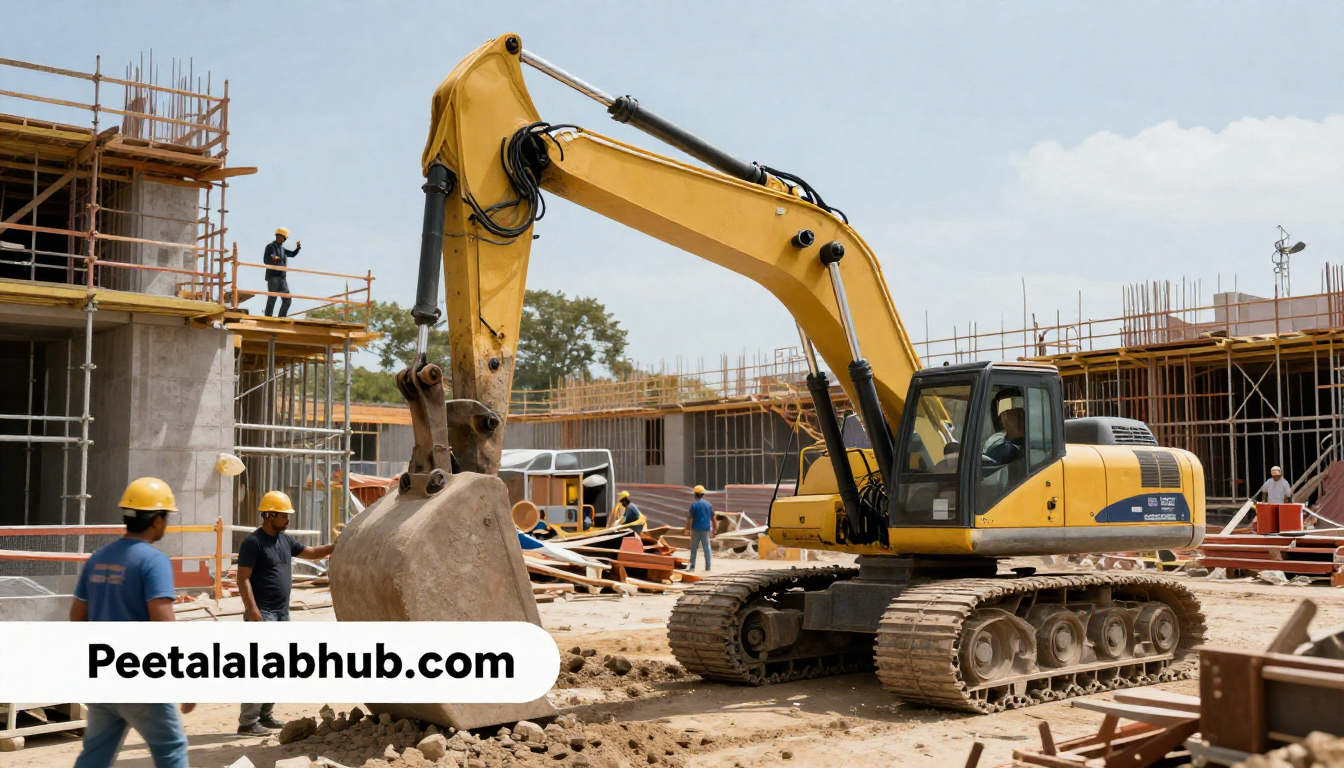
Excavators are the backbone of groundworks on any construction site. They dig foundations, trenches, and drainage runs. They move earth, break up concrete, and load materials into trucks. The operator’s skill level makes an enormous difference — a good excavator operator can work with remarkable precision in tight spaces.
Tower Cranes
Tower cranes are the most visible element of any large construction site. They lift materials — steel, concrete, prefabricated panels, equipment — from the ground up to height. A tower crane operator works from a cab at the very top of the mast, often guided by banksmen on the ground who communicate via radio.
Concrete Mixers and Pumps
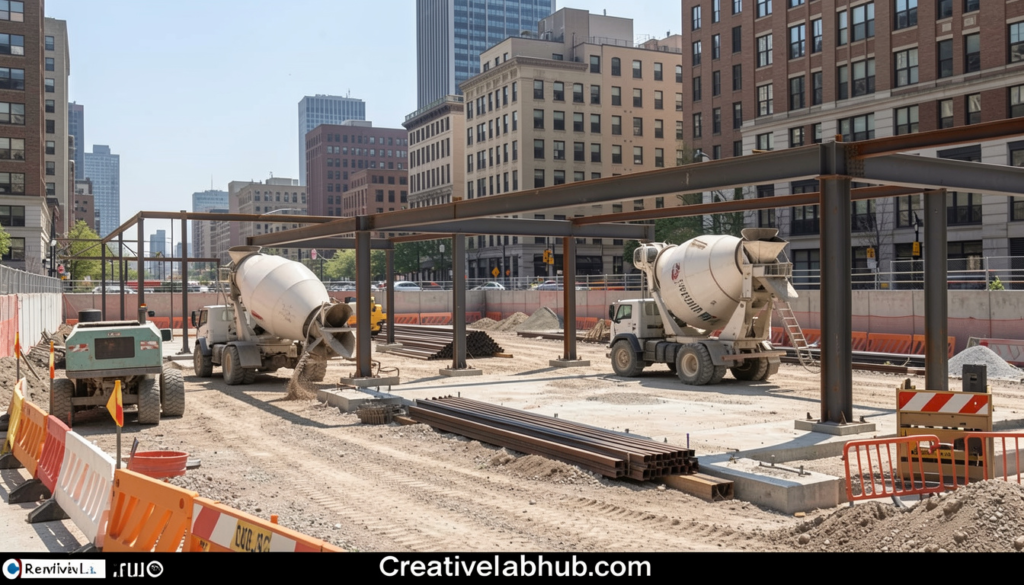
Concrete is one of the most widely used materials on any construction site, and getting it to where it needs to go requires dedicated equipment. Concrete mixer trucks arrive from batching plants and pour directly into pumps, which push the concrete through pipes and hoses to the exact pour location. On tall buildings, concrete pumping is a remarkable feat of logistics.
Scaffolding
Scaffolding isn’t exactly a machine, but it’s critical infrastructure on any construction site working above ground level. Modern scaffolding systems are engineered structures in their own right. They provide safe working platforms, access routes, and protection for the public below. Scaffold erection and dismantling are skilled trades governed by strict safety standards.
Telehandlers and Forklifts
Telehandlers — telescopic handlers — are the workhorses of material movement on a construction site. They lift and place pallets of materials at height and across rough terrain. Forklifts serve a similar function in flatter, more organized areas. Both require operator certification and are involved in a significant number of site accidents when used incorrectly.
Construction Site Planning: How Builds Are Organized Over Time
A construction site doesn’t just happen. Every project follows a programme — a detailed schedule that maps out what needs to happen, in what order, and by when.
The Construction Programme
The programme on a construction site is usually shown as a Gantt chart. It breaks the project into phases and activities, assigns durations and resources, and identifies the critical path — the sequence of activities that determines the overall project duration. Delay any task on the critical path and the entire project slips.
Construction site programmes have to account for dependencies between trades, lead times for materials and equipment, weather delays, and regulatory approvals like inspections. Building a realistic programme is both a science and an art.
Logistics Planning on a Construction Site
On constrained urban construction sites, logistics planning is often as complex as the build itself. Where do deliveries arrive? Where does waste leave? Where do workers park? How do materials get from the delivery point to the point of use? All of these questions need answers before work begins.
A construction logistics plan — also called a site logistics plan — maps out traffic movements, storage areas, welfare locations, and access routes. On tight city-centre sites, deliveries might be timed to the minute to avoid congestion.
Common Challenges on a Construction Site
Even the best-planned construction site faces challenges. Understanding these helps you appreciate why construction projects often run over time and over budget — and what good management does to prevent it.
Weather Delays
Weather is one of the most unpredictable factors on any construction site. Heavy rain can halt groundworks and concrete pours. High winds stop crane operations. Frost affects concrete curing. Snow creates access and safety issues. Experienced site managers build weather contingency into their programmes, but extended bad spells can still have significant impacts.
Supply Chain Disruptions
Materials not arriving on time is a chronic challenge on construction sites globally. The COVID-19 pandemic exposed just how fragile construction supply chains are, with shortages of timber, steel, and electrical components causing widespread project delays. Good procurement planning — ordering materials well ahead of need — is essential for keeping a construction site moving.
Labour Shortages
The construction industry in many countries faces a serious skills shortage. An ageing workforce, fewer young people entering the trades, and competition from other industries all contribute to labour gaps on construction sites. This drives up costs, extends programmes, and puts pressure on the workers who are available.
Design Changes
Changes to the design during construction are one of the most disruptive things that can happen on a construction site. Every change has knock-on effects — materials already ordered may no longer be suitable, work already done may need undoing, and the programme shifts. Managing change effectively requires clear communication between the design team, the client, and the site team.
Conclusion
A construction site is one of the most complex, dangerous, and impressive environments in the modern world. From the moment the hoarding goes up to the day the keys are handed over, a construction site is a constantly evolving system of people, machines, materials, and decisions. Every building you’ve ever walked into, every road you’ve ever driven on, every bridge you’ve crossed — all of it started on a construction site just like the ones you pass every day.
The key things to take away are clear. Safety comes first, always — the statistics don’t lie, and good site safety culture saves lives. Management structure matters enormously — a well-run construction site is organized, communicative, and proactive. Equipment, planning, and logistics all work together to turn a programme on paper into a real, physical structure.
Next time you walk past a construction site, take a moment to really look. You’ll see it differently now — not as noise and disruption, but as one of the most impressive feats of human coordination happening right in front of you. Have you ever worked on a construction site, or do you have questions about how a particular type of build works? Drop a comment below — I’d genuinely love to hear your experience.
FAQs About Construction Sites
Q: What is a construction site? A: A construction site is any location where building, infrastructure, or civil engineering work is actively underway. It includes residential, commercial, and public works projects of all sizes.
Q: What PPE is required on a construction site? A: The minimum standard PPE includes a hard hat, high-visibility vest, steel-toed boots, safety glasses, and gloves. Additional PPE is required depending on specific tasks and hazards.
Q: Who is in charge of a construction site? A: The site manager or site agent runs day-to-day operations on a construction site. They report to the project manager, who oversees the overall programme, budget, and client relationship.
Q: What are the most dangerous hazards on a construction site? A: Falls from height are the leading cause of construction fatalities. Other major hazards include being struck by objects, electrocution, machinery entrapment, and manual handling injuries.
Q: Why do construction sites use so many subcontractors? A: Most construction work requires specialist trades — structural steel, MEP, roofing, and so on. Main contractors coordinate these specialists rather than employing every trade directly, which is more efficient and flexible.
Q: How long does it take to set up a construction site? A: Site establishment can take anywhere from a few days for a small residential project to several months for a large commercial or infrastructure project. It includes securing the perimeter, setting up offices, and establishing logistics.
Q: What regulations govern construction site safety? A: In the UK, CDM Regulations govern construction site safety. In the US, OSHA sets federal standards. Most countries have equivalent national legislation covering worker safety, welfare, and site management.
Q: What causes construction projects to run over time? A: Common causes include weather delays, supply chain disruptions, labour shortages, design changes, and unforeseen ground conditions. Good programme management and contingency planning reduce but rarely eliminate these risks.
Q: What does a construction site logistics plan cover? A: It covers delivery schedules, traffic routes, material storage areas, waste management, worker access, and welfare facility locations. It’s essential for keeping a busy construction site organized and safe.
Q: Can the public visit a construction site? A: Generally, no. Construction sites are restricted to authorized personnel for safety reasons. Some projects offer organized public viewing opportunities, but casual access is prohibited on virtually every active construction site.
Also Read: Pink Wallpaper
| Author: Johan Harwen |
| E-mail: johanharwen314@gmail.com |
| Bio: Johan Harwen is a passionate tourist who has explored countless destinations across the globe. With an eye for hidden gems and local cultures, he turns every journey into an unforgettable story worth sharing. |