
Atomic Radius Trend: The Complete Guide to Understanding Periodic Patterns 2026
Introduction
Have you ever wondered why atoms aren’t all the same size? Picture the periodic table as a map where every element has its unique spot. Now imagine that each element also has a specific size. The atomic radius trend helps you predict whether an atom will be large or small based on its position.
Understanding the atomic radius trend is crucial for chemistry students and professionals alike. It explains why sodium reacts violently with water while neon sits there doing absolutely nothing. This trend reveals the invisible forces that shape chemical behavior.
In this guide, you’ll discover exactly how atomic radius changes across periods and down groups. You’ll learn the science behind these patterns, see real-world examples, and understand why this trend matters. By the end, you’ll be able to predict atomic sizes like a pro and understand the fundamental forces that govern the periodic table.
What Is Atomic Radius?
Before diving into trends, you need to understand what atomic radius actually means. It’s the distance from the nucleus to the outermost electron shell. Think of it as measuring the “reach” of an atom.
Scientists measure atomic radius in picometers (pm) or angstroms (Å). One picometer equals one trillionth of a meter. These measurements are incredibly small. To put it in perspective, you could line up about 5 million carbon atoms across the period at the end of this sentence.
There are several types of atomic radius. Covalent radius measures half the distance between two bonded atoms. Metallic radius applies to metals in their solid state. Van der Waals radius measures non-bonded atoms. For most discussions about the atomic radius trend, we focus on covalent radius.
You can’t directly see or measure a single atom’s radius. Instead, scientists use X-ray crystallography and other techniques. They measure distances between atoms in molecules and crystals, then calculate individual atomic radii.
Why Atomic Radius Matters
Atomic radius affects everything in chemistry. It determines how atoms bond, how they react, and which compounds they form. Smaller atoms form stronger bonds because their electrons are closer to the nucleus. Larger atoms are often more reactive because their outer electrons are loosely held.
Understanding atomic size helps predict molecular geometry. It explains why certain elements substitute for others in crystal structures. The pharmaceutical industry uses these principles when designing drugs that fit specific receptor sites in your body.
The Periodic Trend Across Periods
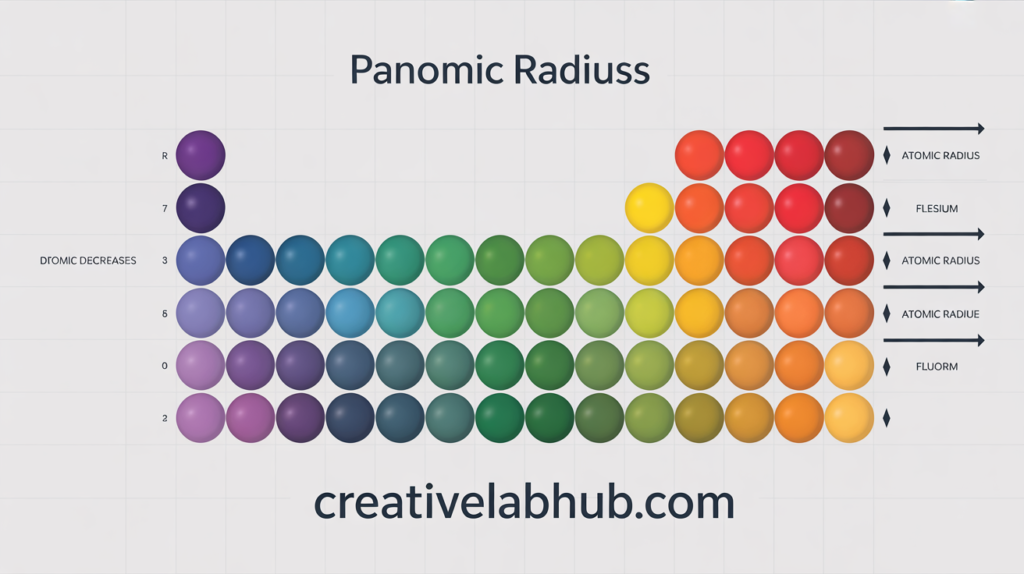
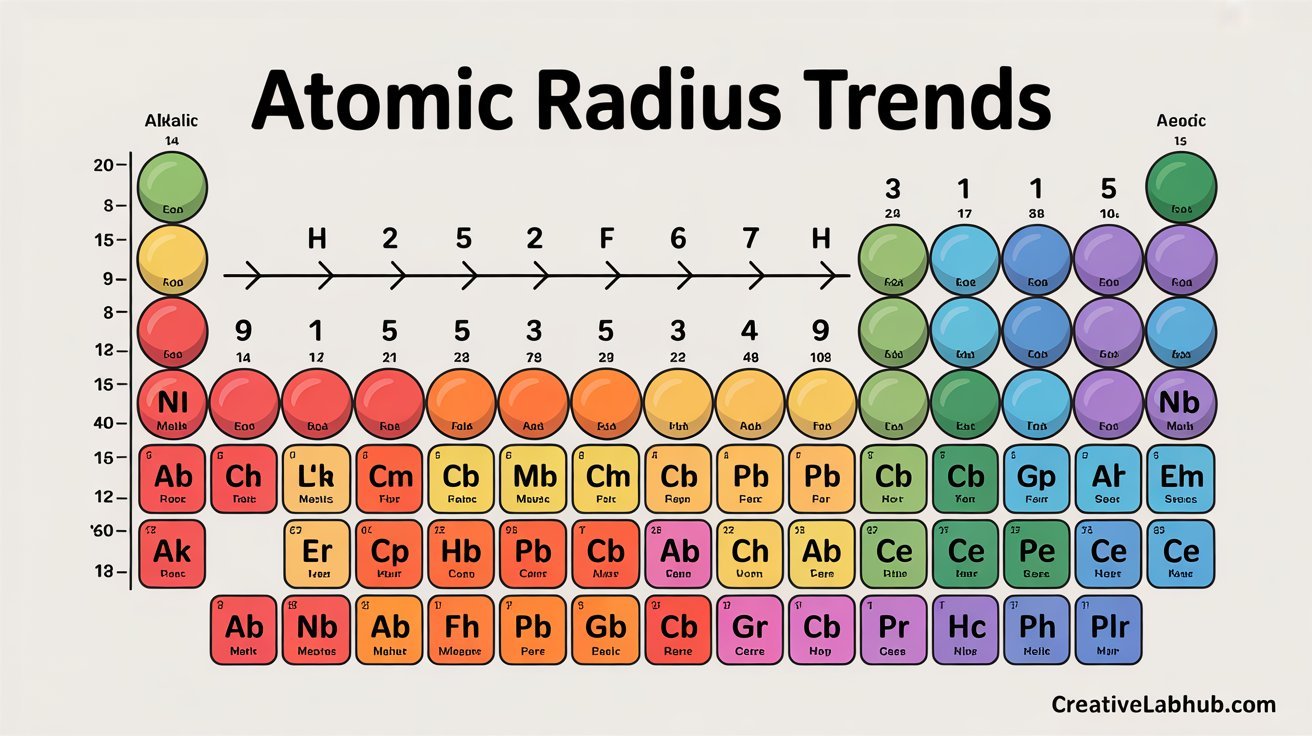
Here’s where the atomic radius trend gets fascinating. As you move from left to right across a period, atomic radius decreases. This seems counterintuitive at first. You’re adding electrons, so shouldn’t atoms get bigger?
The answer lies in the nucleus. Each step to the right adds one proton to the nucleus and one electron to the same shell. The increased nuclear charge pulls all electrons closer. This stronger attraction outweighs the electron-electron repulsion.
The Science Behind the Decrease
Let’s look at Period 2 as an example. Lithium has 3 protons and an atomic radius of about 152 pm. Fluorine has 9 protons and a radius of only 64 pm. Both elements have electrons in the same principal energy level (n=2).
The nuclear charge in fluorine is three times stronger than lithium. Those 9 protons create a powerful pull on the electron cloud. The electrons can’t shield each other effectively because they’re in the same shell. This creates what chemists call “poor shielding.”
Think of it like a rope-pulling contest. More protons on one side mean a stronger pull toward the center. The electrons get dragged closer to the nucleus. The result? A smaller atomic radius.
Real-World Examples
Compare sodium (186 pm) to chlorine (99 pm) in Period 3. Sodium readily loses its outer electron to form Na⁺. Chlorine desperately wants to gain an electron to form Cl⁻. This difference in atomic size explains their opposite chemical behaviors.
The transition metals show smaller decreases across periods. They’re adding electrons to inner d-orbitals while the outer s-orbital remains similar. This creates less dramatic changes in atomic radius compared to main-group elements.
The Periodic Trend Down Groups
Moving down a group shows the opposite trend. Atomic radius trend down groups is an increase in size. This makes perfect sense when you understand electron shells.
Each period down adds a new principal energy level. Lithium has 2 shells, sodium has 3, potassium has 4, and so on. More shells mean the outer electrons are farther from the nucleus.
Shielding Effect Explained
Inner electrons shield outer electrons from the full nuclear charge. Think of it as layers of protection. Each inner shell reduces the pull that outer electrons feel from the nucleus.
The effective nuclear charge (Z_eff) is what outer electrons actually experience. It equals the total nuclear charge minus the shielding from inner electrons. As you go down a group, Z_eff increases slightly, but the distance effect dominates.
For example, the alkali metals show dramatic size increases:
- Lithium: 152 pm
- Sodium: 186 pm
- Potassium: 227 pm
- Rubidium: 248 pm
- Cesium: 265 pm
Each element has one more electron shell than the one above it. The outermost electron sits farther from the nucleus despite the increased nuclear charge.
Why Distance Wins
Nuclear charge increases down a group, which should pull electrons closer. However, the distance factor overwhelms this effect. Electrostatic attraction follows an inverse-square law. Double the distance, and the force drops to one-quarter.
The outermost electron in cesium is approximately 4 times farther from the nucleus than in lithium. Even though cesium has 52 more protons, the distance makes its outer electron much more loosely held. This explains why cesium is far more reactive than lithium.
Exceptions to the Atomic Radius Trend
Chemistry wouldn’t be chemistry without exceptions. The atomic radius trend has several notable deviations that actually make the patterns more interesting.
The Scandide Contraction
The first row of transition metals shows an unusual plateau. From scandium to zinc, atomic radii decrease, but not smoothly. Some elements show very similar sizes. This happens because d-electrons shield poorly, creating unpredictable effective nuclear charges.
The Lanthanide Contraction
This is the most famous exception. The lanthanide series (elements 57-71) shows a steady decrease in atomic radius. When you reach the elements after the lanthanides, they’re unexpectedly small.
Gold and silver illustrate this beautifully. You’d expect gold (Period 6) to be much larger than silver (Period 5). Instead, gold (144 pm) is only slightly larger than silver (144 pm). The lanthanide contraction made gold’s atoms smaller than expected.
This contraction affects the entire 6th period. It explains why platinum has similar chemical properties to palladium, and why gold is so chemically stable. The lanthanide contraction even influences the color of gold—the contracted orbitals affect how gold absorbs light.
Noble Gas Confusion
Noble gases present a measurement challenge. They don’t form covalent bonds easily, so measuring covalent radius is difficult. Scientists use Van der Waals radii instead. This makes noble gases appear larger than the halogens next to them, which seems to break the periodic trend.
However, if you could measure true covalent radii for noble gases, they’d be the smallest in their periods. The trend still holds—the measurement method just differs.
Factors That Influence Atomic Radius
Multiple forces work together to determine atomic size. Understanding these factors helps you predict the atomic radius trend in complex situations.
Nuclear Charge (Z)
More protons mean stronger attraction. This is straightforward. Each additional proton pulls electrons closer to the nucleus. Nuclear charge is the primary driver of the periodic trend across periods.
Electron Shells (n)
The principal quantum number determines the average distance of electrons from the nucleus. Higher n means larger atomic radius. This dominates the trend down groups.
Shielding and Penetration
Inner electrons block the nuclear charge from reaching outer electrons. However, not all electrons shield equally well. S-electrons penetrate closer to the nucleus than p-electrons, which penetrate more than d-electrons.
This explains subtle variations in the periodic trend. It’s why transition metals show smaller radius changes than main-group elements.
Electron-Electron Repulsion
Electrons repel each other. As you add electrons to the same shell (across a period), this repulsion increases. However, the increasing nuclear charge overpowers this effect. Repulsion matters more in ions than neutral atoms.
Ionic Radius vs. Atomic Radius
Ions behave differently from neutral atoms. When atoms lose or gain electrons, their sizes change dramatically. This connects directly to the atomic radius trend but adds another layer of complexity.
Cations Are Smaller
Positive ions are always smaller than their parent atoms. Sodium (186 pm) becomes Na⁺ (102 pm). Removing an electron often eliminates an entire shell. Even when it doesn’t, the reduced electron-electron repulsion allows the nucleus to pull remaining electrons closer.
The more positive the charge, the smaller the ion. Fe²⁺ is larger than Fe³⁺. This makes sense—fewer electrons mean less repulsion and stronger effective nuclear pull.
Anions Are Larger
Negative ions are bigger than their parent atoms. Chlorine (99 pm) becomes Cl⁻ (181 pm). Adding electrons increases repulsion. The nuclear charge stays the same, but it’s now spread over more electrons.
The electron cloud expands to accommodate the extra electrons. This is why ionic compounds containing anions need more space in crystal structures.
Isoelectronic Series
Ions with the same electron configuration show interesting patterns. Consider O²⁻, F⁻, Na⁺, and Mg²⁺. All have 10 electrons (like neon). However, their sizes differ dramatically:
- O²⁻: 140 pm
- F⁻: 133 pm
- Ne: 69 pm
- Na⁺: 102 pm
- Mg²⁺: 72 pm
More protons mean smaller radius in an isoelectronic series. The nuclear charge pulls the same number of electrons closer.
Practical Applications of Atomic Radius Trends
Understanding the atomic radius trend isn’t just academic. This knowledge drives innovation across multiple fields.
Materials Science
Engineers design alloys by substituting atoms of similar size. Brass contains copper and zinc—elements with similar atomic radii that form solid solutions. If the size difference exceeds 15%, atoms won’t substitute well. The material becomes brittle or weak.
Steel manufacturing uses atomic radius principles. Adding small carbon atoms to iron’s crystal structure creates interstitial alloys. The carbon fits in the spaces between iron atoms. This strengthens the metal without requiring similar-sized atoms.
Drug Design
Pharmaceutical chemists use atomic radius to design drug molecules. Drugs must fit into specific protein binding sites. If atoms are too large, the drug won’t bind. Too small, and it won’t interact properly.
Fluorine often substitutes for hydrogen in drugs. Fluorine is larger but forms stronger bonds. This slight size increase changes how drugs interact with your body. It can improve effectiveness and reduce side effects.
Catalysis
Catalysts work by bringing molecules together at specific distances. Platinum is an excellent catalyst partly because of its atomic radius. It spaces reactive molecules at optimal distances for chemical reactions.
Zeolites use atomic radius principles for selective catalysis. These materials have precise pore sizes. Only molecules of certain sizes can enter. This creates reactions that are impossible in bulk solution.
Environmental Chemistry
Heavy metals are toxic partly due to their atomic radius. Lead can substitute for calcium in bone tissue because their ionic radii are similar. Your body can’t distinguish between them. However, lead is much more toxic.
Understanding ionic radius helps design materials that selectively remove pollutants. Ion exchange resins use cavities sized for specific pollutants. Water treatment facilities rely on these principles daily.
How to Predict Atomic Radius
You can estimate atomic radius without memorizing every value. Use the atomic radius trend rules as your guide.
Start with the periodic table position. Elements in the lower left are largest. Elements in the upper right are smallest. This gives you a general framework.
Compare elements in the same period. The element farther left is larger. Sodium is larger than chlorine because it’s farther left in Period 3.
Compare elements in the same group. The element farther down is larger. Cesium is larger than lithium because it’s farther down Group 1.
For diagonal comparisons, consider both factors. Moving right and up both decrease size. Moving left and down both increase size. If you move right and down (or left and up), consider which factor dominates. Usually, the vertical trend (adding shells) is stronger than the horizontal trend (increasing nuclear charge).
Quick Estimation Technique
I use this method when teaching: assign points for position. Give +1 for each period down from the top. Give -1 for each group to the right. Higher scores mean larger atoms.
This isn’t perfect, but it works for quick comparisons. It helps you think through the competing factors systematically.
Common Misconceptions About Atomic Radius
Let me clear up some confusion about the atomic radius trend. These misconceptions trip up even advanced chemistry students.
“More Electrons Always Means Bigger”
This seems logical but ignores nuclear charge. Fluorine has more electrons than lithium but is much smaller. The nuclear charge effect dominates when electrons fill the same shell.
“All Atoms in a Group Increase by the Same Amount”
The increase isn’t constant down groups. The jump from Period 1 to 2 is large. Later jumps are progressively smaller. Relativistic effects also influence very heavy atoms, making predictions complex.
“Atomic Radius Is a Fixed Number”
Atomic radius changes based on bonding environment. A carbon atom in diamond has a different effective radius than carbon in graphite. Temperature and pressure also affect atomic spacing in crystals.
“Noble Gases Are Smaller Than Halogens”
This confusion stems from measurement methods. Van der Waals radii make noble gases appear larger. If you could measure covalent radii, noble gases would be smallest in their periods as the trend predicts.
Measuring and Calculating Atomic Radius
Scientists use sophisticated techniques to determine atomic size. Understanding these methods reveals the atomic radius trend isn’t just theoretical—it’s measurable and precise.
X-ray Crystallography
This is the primary method for measuring atomic distances. Scientists shine X-rays through crystals. The X-rays diffract based on atomic spacing. By analyzing the diffraction pattern, researchers calculate exact distances between atoms.
The technique measures bond lengths, then divides by two for covalent radius. This assumes atoms split the bond distance equally. For similar atoms, this works well. For different atoms, adjustments are necessary.
Quantum Mechanical Calculations
Modern computational chemistry calculates atomic radius from first principles. Software solves the Schrödinger equation for atoms and molecules. This predicts electron density distributions.
Scientists define atomic radius as where electron density drops to a certain threshold. Different thresholds give slightly different values. This explains why sources sometimes list different atomic radii for the same element.
Experimental Challenges
Measuring atomic radius for isolated atoms is nearly impossible. You need atoms in molecules or crystals to have reference points. This means atomic radius is always somewhat dependent on chemical environment.
For unstable elements, measurements are extremely difficult. Scientists might have only a few atoms to study. Some reported atomic radii are educated estimates rather than precise measurements.
Teaching the Atomic Radius Trend
If you’re learning this for an exam or teaching others, here’s what works. The atomic radius trend makes sense when you connect it to fundamental forces.
Focus on the two main trends first: decreases across periods, increases down groups. Master these before worrying about exceptions.
Use concrete examples. Compare lithium to fluorine for the period trend. Compare lithium to cesium for the group trend. Physical demonstrations help—show models of different-sized atoms.
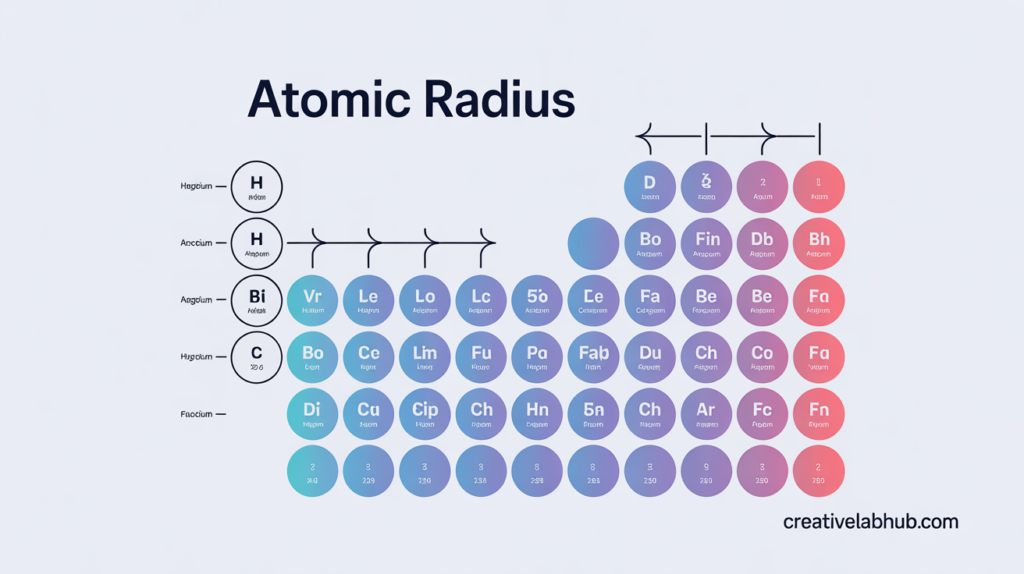
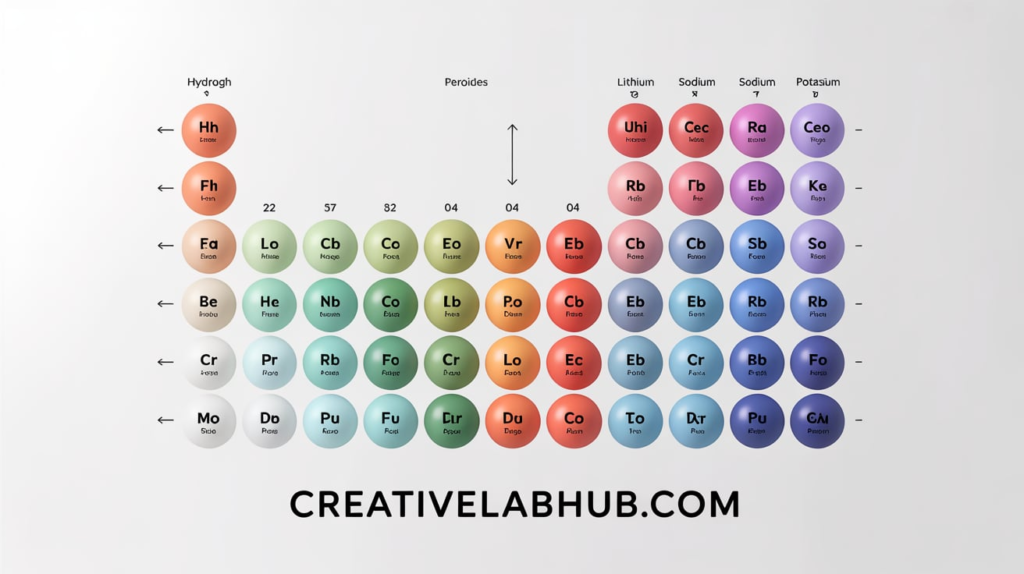
Draw the periodic table and add arrows. A left-pointing arrow shows decreasing size across periods. A downward-pointing arrow shows increasing size down groups. This visual sticks in memory.
Practice with prediction exercises. Give students two elements and ask which is larger. Force them to explain using nuclear charge, shielding, and electron shells. Understanding the reasoning matters more than memorizing values.
Connect to observable properties. Larger atoms are often more reactive. They form longer bonds. This makes the trend relevant beyond just numbers.
Atomic Radius in Advanced Chemistry
The atomic radius trend extends into sophisticated chemical concepts. These applications show why understanding basic trends is so powerful.
Coordination Chemistry
Transition metals form complexes with specific geometries. The metal’s atomic radius affects how many ligands can coordinate. Smaller metals favor fewer ligands. Larger metals accommodate more.
Crystal field splitting depends on metal-ligand distances. Smaller metals create larger splitting because ligands approach more closely. This affects color, magnetism, and reactivity of complexes.
Organometallic Chemistry
Carbon-metal bond lengths reflect both atoms’ radii. These bond lengths determine reaction rates. Shorter bonds are often more reactive because orbitals overlap better.
Steric effects in organometallic catalysts depend on metal radius. A larger metal creates more space around the reactive center. This allows bulkier substrates to react.
Solid State Chemistry
Ionic crystal structures depend critically on radius ratios. The ratio of cation to anion radius determines structure type. Sodium chloride has one structure. Cesium chloride, with a larger cation-anion ratio, has a different structure.
Band gaps in semiconductors correlate with atomic radius. Smaller atoms often create larger band gaps. This affects electrical and optical properties. Silicon and germanium illustrate this—germanium’s larger atoms contribute to its smaller band gap.
Conclusion
The atomic radius trend is one of chemistry’s most elegant patterns. Atoms get smaller across periods as nuclear charge increases. They get larger down groups as new electron shells are added. These simple rules explain countless chemical properties and predict atomic behavior across the periodic table.
You’ve learned that atomic radius isn’t arbitrary—it results from the balance between nuclear attraction and electron repulsion. Factors like shielding, penetration, and effective nuclear charge fine-tune these trends. Exceptions like the lanthanide contraction remind us that chemistry is complex, but patterns still emerge.
This knowledge isn’t just for exams. Materials scientists use it to design new alloys. Drug developers use it to create effective medicines. Environmental engineers use it to remove pollutants. Understanding atomic radius helps you understand matter itself.
Next time you look at the periodic table, see it as a map of atomic sizes. Each element has its place not just by atomic number, but by the size of its atoms. This spatial arrangement reveals the fundamental forces that shape our molecular world.
What element are you most surprised to learn about in terms of atomic size? Share your thoughts in the comments below.
FAQs
What is the atomic radius trend on the periodic table? Atomic radius decreases from left to right across periods and increases from top to bottom down groups. This happens because nuclear charge increases across periods, pulling electrons closer, while new electron shells are added down groups, pushing electrons farther from the nucleus.
Why does atomic radius decrease across a period? As you move right across a period, each element adds one proton and one electron to the same shell. The increased nuclear charge pulls all electrons closer to the nucleus. Since electrons are added to the same energy level, they shield each other poorly. The stronger nuclear attraction wins, decreasing atomic radius.
Which element has the largest atomic radius? Francium (Fr) has the largest atomic radius of all elements at approximately 348 pm. It’s located in the bottom-left corner of the periodic table—exactly where the trends predict the largest atom should be. However, francium is extremely rare and radioactive, so this value is estimated rather than precisely measured.
Why does atomic radius increase down a group? Each period down a group adds a new principal energy level (electron shell). These additional shells place outer electrons farther from the nucleus. Although nuclear charge also increases down a group, the distance effect dominates. Inner electrons shield outer electrons from the nuclear charge, making the outermost electrons loosely held.
Is ionic radius the same as atomic radius? No, ionic radius differs from atomic radius. Cations (positive ions) are smaller than their parent atoms because they lose electrons and have stronger effective nuclear charge. Anions (negative ions) are larger than their parent atoms because they gain electrons, increasing electron-electron repulsion and expanding the electron cloud.
What is the lanthanide contraction? The lanthanide contraction is the greater-than-expected decrease in atomic radius across the lanthanide series (elements 57-71). This happens because f-electrons shield nuclear charge poorly. The contraction affects all elements following the lanthanides, making Period 6 elements surprisingly similar in size to Period 5 elements directly above them.
How do you measure atomic radius? Scientists measure atomic radius primarily through X-ray crystallography. X-rays diffract through crystals, revealing distances between atoms. Covalent radius equals half the distance between two bonded identical atoms. For metals, metallic radius is used. For noble gases, Van der Waals radius is measured instead since they rarely form covalent bonds.
Why are noble gases larger than halogens in measurements? Noble gases appear larger because scientists measure Van der Waals radius rather than covalent radius. Noble gases don’t typically form covalent bonds. Van der Waals radius measures non-bonded atoms, which appear larger. If you could measure covalent radius, noble gases would be the smallest elements in their periods as the trend predicts.
Does atomic radius affect chemical reactivity? Yes, atomic radius significantly affects reactivity. Larger atoms are often more reactive because their outer electrons are farther from the nucleus and more easily lost. This is why cesium is more reactive than lithium, and why fluorine (small) is more reactive than iodine (large) when gaining electrons—smaller atoms attract electrons more strongly.
What are exceptions to the atomic radius trend? Major exceptions include the lanthanide contraction, the scandide contraction in transition metals, and apparent reversals with noble gases. Transition metals show smaller, less regular decreases across periods because d-electrons shield poorly. Very heavy elements experience relativistic effects that alter expected sizes. Despite exceptions, the general trend remains useful for predictions.
Also Read : SEO Agency Interamplify