

What Is Palm Sunday? The Powerful Truth Behind This Sacred Day In 2026
Introduction
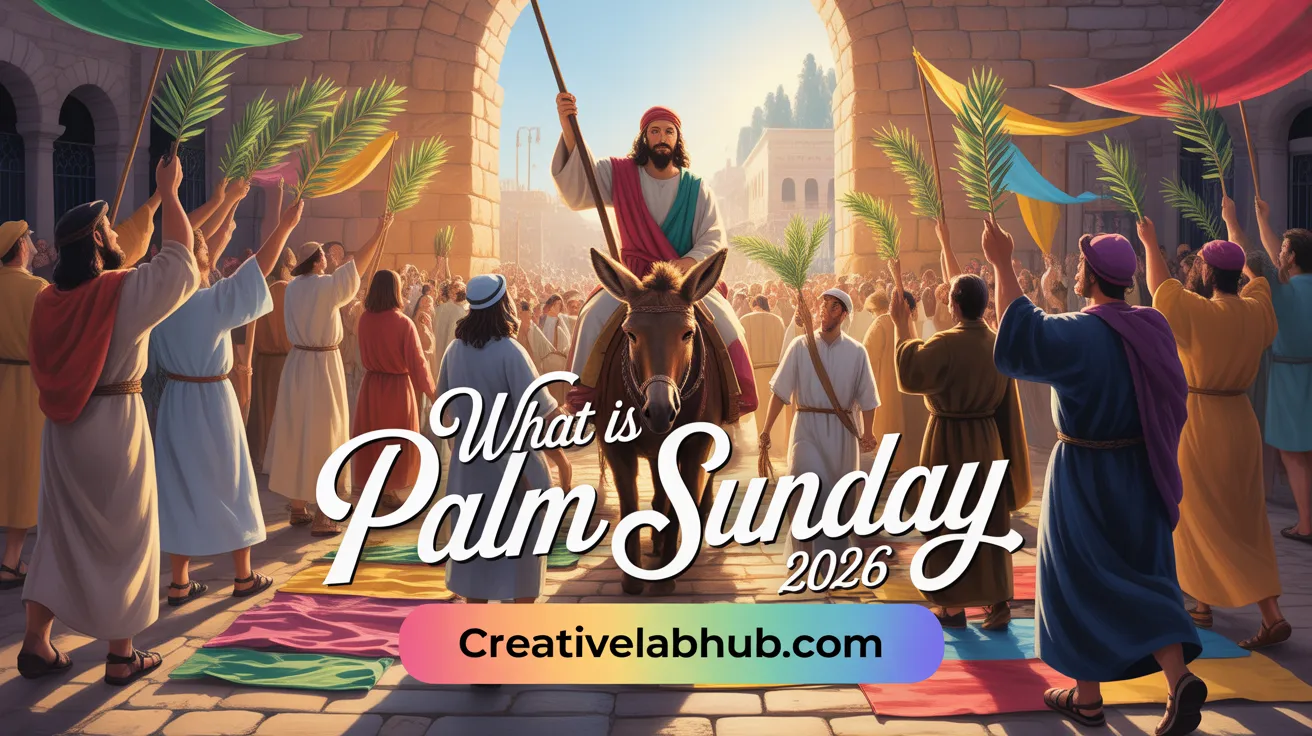
Imagine thousands of people lining a dusty road, waving palm branches and shouting with joy as a Kind personality rides on a donkey. That scene happened roughly 2,000 years ago, and it still continues the hearts of millions today. So, what is Palm Sunday? It is the Christian holiday that commemorates Jesus Christ’s triumphant entry into Jerusalem. It falls on the Sunday before Easter and opens the final week of the Christian calendar called as Holy Week.
You might have seen people carrying palm branches at church, heard the word “Hosanna” in a hymn, or watched a Palm Sunday procession on television. But do you know the real story behind this day? In this article, you will learn the history, meaning, traditions, and significance of Palm Sunday, all explained in a clear and simple way.
What Is Palm Sunday? A Simple, Clear Definition
Palm Sunday is the first day of Holy Week in the Christian faith. It marks the moment when Jesus rode into Jerusalem on a donkey while crowds greeted him by spreading palm branches and cloaks on the road. Christians around the world celebrate this event every year on the Sunday that comes exactly one week before Easter Sunday.
The name comes directly from those palm branches the crowds waved and placed on the ground. In ancient times, people used palm branches as a symbol of victory and royalty. The crowds were essentially welcoming Jesus as a king. This moment is recorded in all four Gospels: Matthew, Mark, Luke, and John. That level of consistency across all four accounts shows how significant this event was.
If someone asks you what is Palm Sunday in one sentence, you can say: it is the day Christians remember Jesus entering Jerusalem as a king, just days before his crucifixion and resurrection.
The Biblical Story Behind Palm Sunday
The Palm Sunday story begins just outside Jerusalem, near the villages of Bethphage and Bethany on the Mount of Olives. Jesus sent two of his disciples ahead to find a donkey. He told them exactly where to find it and what to say if anyone questioned them. They brought the donkey back, placed their cloaks on it, and Jesus rode into the city.
As he rode, the crowd responded in a remarkable way. Here is what the Bible describes:
- People spread their cloaks on the road as a sign of honor.
- Others cut palm branches from nearby trees and laid them down.
- The crowd cried out “Hosanna” which means “save us” or “we pray, save us.”
- They called Jesus the “Son of David,” a title reserved for the Messiah.
This was not a quiet, private moment. It was a public, loud, joyful declaration. The Pharisees in the crowd were disturbed and asked Jesus to silence his followers. His answer was simple and direct: if the people kept quiet, even the stones would cry out. That tells you how momentous this entry into Jerusalem truly was.
Why Did Jesus Ride a Donkey?
Many people wonder why Jesus chose a donkey rather than a horse. A horse symbolized military power and conquest. A donkey symbolized humility and peace. By riding a donkey, Jesus fulfilled a prophecy from the book of Zechariah (9:9): “See, your king comes to you, gentle and riding on a donkey.” He was sending a clear message. He did not come as a military conqueror. He came as a servant king who brings peace.
The History of Palm Sunday Celebrations Through the Centuries
The earliest Christians did not immediately create a formal celebration for Palm Sunday. The first known organized observance dates back to around the 4th century in Jerusalem. A Spanish nun named Egeria documented a Palm Sunday procession in Jerusalem around 381 AD. In her diary, she described how bishops, clergy, and faithful people walked down the Mount of Olives holding branches of palms and olives, singing Hosanna.
By the 7th century, the practice had spread to other parts of the Christian world. In medieval Europe, Palm Sunday processions became elaborate community events. People carried not just palm branches but also flowers, crosses, and religious banners. In many regions where palm trees did not grow, churches substituted other plants like willow, yew, or box branches.
Today, Palm Sunday is one of the most widely observed days in the Christian calendar. According to the Pew Research Center, Christianity is the world’s largest religion with about 2.4 billion followers. The vast majority of them, across Catholic, Protestant, Eastern Orthodox, and other traditions, mark Palm Sunday every year.
How Do Christians Celebrate Palm Sunday Today?
Walk into almost any Christian church on Palm Sunday morning and you will see something distinctive: palm branches. Churches distribute them to worshippers at the start of the service. Some congregations hold outdoor processions before entering the church, re-enacting the crowd’s welcome of Jesus. Children often lead these processions, waving palms and singing.
Here are some of the most common Palm Sunday traditions you will find around the world:
- Palm Distribution: Churches give out palm fronds at the service entrance. Worshippers hold them during worship.
- Reading of the Passion: Many churches read the full Passion narrative, covering Jesus’ arrest, trial, and crucifixion. This sets the tone for Holy Week.
- Processions: Outdoor walks recreate the original entry. In Jerusalem, thousands of pilgrims still walk down the Mount of Olives every year.
- Palm Weaving: In many Latin American and Asian communities, artisans weave intricate shapes out of palm leaves, from crosses to flowers to animals.
- Saving Palms for Ash Wednesday: Many Christians keep their palm branches all year. Churches then burn them to create the ashes used on Ash Wednesday the following year.
Palm Sunday Around the World
Palm Sunday looks different depending on where you are in the world. In the Philippines, one of the most Catholic countries globally, people create giant palm structures called “palaspas” decorated with elaborate woven designs. In Ethiopia, the Ethiopian Orthodox Church celebrates “Hosanna” with colorful processions and traditional music. In Mexico and Central America, street markets sell intricately folded palm crosses in the days leading up to the holiday.
In the United States and United Kingdom, Palm Sunday services tend to blend solemnity with celebration. The mood is joyful at the start of the service but grows more serious as the Passion story is read aloud. That shift in tone is intentional. It reminds you that the same crowd shouting Hosanna would be calling for crucifixion just five days later.
The Deep Spiritual Meaning of Palm Sunday
Palm Sunday carries layers of meaning that go beyond the surface level event. On one level, it is a moment of joy and triumph. On another level, it holds a painful irony. The crowds welcomed Jesus as a king who would overthrow Roman rule. But Jesus came for a completely different kind of kingdom. He was not there to liberate people politically. He came to offer something far greater: forgiveness of sin and eternal life.
The contrast between the joyful entry and the suffering that followed is one of the most emotionally powerful themes in Christian theology. In just five days, the same city that celebrated Jesus would hand him over to be crucified. Theologians often point to this as a reminder of human fickle-ness and the gap between what people expect from God and what God actually offers.
Hosanna: What Does It Really Mean?
The word “Hosanna” is one of the most misunderstood words in Christian worship. Many people think it simply means “praise” or “hallelujah.” But it actually comes from the Hebrew words meaning “save us” or “save now.” When the crowd cried Hosanna, they were making a request, not just offering praise. Over time, the word evolved into an expression of joyful worship in Christian tradition. But knowing its original meaning adds depth to what the crowd was really asking for that day.
Palm Sunday vs. Easter: Understanding the Difference
People sometimes confuse Palm Sunday with Easter, or wonder how they relate to each other. Here is the simple distinction: Palm Sunday begins Holy Week, and Easter ends it. Palm Sunday is about celebration and arrival. Easter is about resurrection and new life. The events between them, including the Last Supper (Maundy Thursday), Jesus’ arrest and crucifixion (Good Friday), and the quiet waiting of Holy Saturday, form the dramatic core of the Christian story.
You cannot fully appreciate Easter without understanding Palm Sunday. The triumph of the resurrection is even more powerful when you remember the betrayal, suffering, and death that came between the palm-waving crowd and the empty tomb. Palm Sunday sets the stage for everything that follows.
When Is Palm Sunday? How the Date Is Determined
Palm Sunday does not fall on the same date every year because it is tied to Easter, which is a moveable feast. Easter falls on the first Sunday after the first full moon following the spring equinox. This means Easter can land anywhere between March 22 and April 25. Palm Sunday is always exactly one week before Easter.
Here are the Palm Sunday dates for the next few years:
- 2025: April 13
- 2026: March 29
- 2027: March 21
Note that Eastern Orthodox Christians often celebrate Palm Sunday on a different date than Western Christians, because Eastern Orthodoxy uses the Julian calendar rather than the Gregorian calendar to calculate Easter.
What Happens During Holy Week After Palm Sunday?
Once you understand what is Palm Sunday, it helps to know what the rest of Holy Week looks like. The days that follow are filled with deeply significant events, all leading up to the resurrection on Easter Sunday.
- Monday: Jesus clears the temple in Jerusalem, overturning the tables of money changers.
- Tuesday: Jesus teaches in the temple and responds to questions from Pharisees and scribes.
- Wednesday (Spy Wednesday): Judas agrees to betray Jesus for thirty pieces of silver.
- Thursday (Maundy Thursday): Jesus shares the Last Supper with his disciples and is later arrested in the Garden of Gethsemane.
- Friday (Good Friday): Jesus is tried, crucified, and buried.
- Saturday (Holy Saturday): Jesus lies in the tomb. His followers grieve.
- Sunday (Easter Sunday): The tomb is found empty. Jesus has risen.
Every single one of those days carries meaning. But Palm Sunday is where it all begins. It is the opening act of the most important week in all of Christian history.
Palm Sunday in Art, Culture, and Literature
Palm Sunday has inspired centuries of art, music, and literature. Some of the most famous paintings in Western art history depict the triumphal entry into Jerusalem. Artists like Giotto di Bondone, Pietro Lorenzetti, and Jean-Hyppolite Flandrin all created celebrated versions of this scene. The image of Jesus on a donkey surrounded by palm-waving crowds became one of the defining images of Christian art.
In music, Palm Sunday has inspired countless hymns and choral works. The “Hosanna” is echoed in compositions by Bach, Handel, and modern worship musicians alike. In literature, the triumphal entry appears in novels, poems, and theological essays across multiple languages and centuries.
Even outside strictly religious circles, the phrase “riding in on a donkey” has entered popular culture as a metaphor for humble arrival or unexpected greatness. The cultural footprint of Palm Sunday reaches well beyond the walls of any church.
Conclusion: Why Palm Sunday Still Matters
Now you know what is Palm Sunday in its fullest sense. It is not just a church tradition or a day to wave branches. It is the moment when Jesus publicly declared who he was, the moment when a crowd welcomed him as king, and the moment that set everything in motion for the most transformative week in human history.
Palm Sunday asks each of us a quiet but powerful question: if you had been in that crowd, what would you have been shouting? Would you have understood what kind of king was passing by? The beauty of this day is that you do not need to have been there to answer the question. Every Palm Sunday gives you the chance to reflect on it again.
Whether you are a lifelong Christian, someone curious about faith, or simply someone who wants to understand a holiday millions celebrate, Palm Sunday rewards deeper attention. Share this article with someone who has ever wondered about it. And if you have a favorite Palm Sunday memory or tradition, we would love to hear about it in the comments.
Frequently Asked Questions (FAQs)
1. What is Palm Sunday and why is it celebrated?
Palm Sunday is the Christian observance that commemorates Jesus Christ’s entry into Jerusalem on a donkey, greeted by crowds waving palm branches. It opens Holy Week and falls on the Sunday before Easter. Christians celebrate it to remember this moment of prophetic fulfillment and to begin their spiritual journey toward Good Friday and Easter.
2. What do the palm branches symbolize on Palm Sunday?
Palm branches symbolize victory, royalty, and triumph. In the ancient world, people waved them to honor kings and conquering heroes. By spreading palms before Jesus, the crowd acknowledged him as a king and the long-awaited Messiah.
3. Is Palm Sunday a holy day of obligation for Catholics?
Yes. For Roman Catholics, Palm Sunday is a holy day of obligation, meaning Catholics are required to attend Mass. It is officially called “Palm Sunday of the Passion of the Lord” in the Catholic liturgical calendar.
4. What do you eat on Palm Sunday?
There are no universal food restrictions for Palm Sunday. However, since it falls during Lent, many Christians who observe Lenten fasting continue to abstain from meat on Fridays. In some cultures, special foods are associated with Palm Sunday celebrations, such as “fig Sunday” foods in parts of England or special breads in Eastern European traditions.
5. Why is Palm Sunday also called Passion Sunday?
Palm Sunday is also called Passion Sunday because many churches read the full Passion narrative during the service. The Passion covers Jesus’ suffering, betrayal, trial, and crucifixion. The dual name reflects the two themes of the day: joyful welcome and impending suffering.
6. What do you say on Palm Sunday?
Common greetings on Palm Sunday include “Happy Palm Sunday,” “Blessed Palm Sunday,” and “Hosanna!” In liturgical churches, the priest or pastor often opens the service with “Hosanna to the Son of David! Blessed is he who comes in the name of the Lord!” You can greet fellow Christians warmly and simply on this day.
7. Do non-Christians celebrate Palm Sunday?
Palm Sunday is a specifically Christian holiday. However, people of other faiths or no faith at all may be familiar with it, especially in predominantly Christian countries where it is part of the cultural calendar. Some secular people attend Palm Sunday events out of cultural interest, family tradition, or curiosity.
8. What is the difference between Palm Sunday and Good Friday?
Palm Sunday is a day of joyful welcome. Good Friday is a day of grief and mourning. Palm Sunday marks Jesus’ triumphant entry into Jerusalem. Good Friday marks his crucifixion and death. Both are part of Holy Week, with Good Friday falling four days after Palm Sunday.
9. Where does the Palm Sunday story appear in the Bible?
The Palm Sunday story appears in all four Gospels. You can read it in Matthew 21:1-11, Mark 11:1-11, Luke 19:28-44, and John 12:12-19. Each Gospel adds slightly different details, but all four confirm the core event of Jesus entering Jerusalem on a donkey while crowds waved branches and shouted Hosanna.
10. What is Palm Sunday for kids? How do you explain it simply?
You can explain Palm Sunday to kids like this: “A long time ago, a very special man named Jesus rode into a city on a donkey. The people who loved him were so happy they waved big leaves called palm branches and cheered for him like he was a king. We celebrate that day every year with our own palm branches to remember how much they loved him.” Simple, visual, and true to the story.
Also read Creativelabhub.com
Email: johanharwen314@gmail.com
Author Name: Johan harwen
About the Author: Johan Harwen is a faith-based writer and researcher with a passion for making religious history accessible to everyday readers. With over a decade of experience writing about Christian traditions, theology, and world religions, Johan brings both academic rigor and genuine warmth to every piece. His work has helped thousands of readers around the world connect more deeply with the stories and practices that have shaped human civilization for centuries. When he is not writing, Johan enjoys reading church history, exploring cathedrals, and having long conversations about faith over good coffee.
