
UEFA Women’s Champions League Standings: The Ultimate Unmissable Guide (2025/26)
Introduction
If you follow women’s football, you already know that the UEFA Women’s Champions League is the biggest stage in European club football. But if you have ever tried to make sense of the UEFA Women’s Champions League standings, especially after the 2025/26 season introduced a brand-new format, you might have walked away feeling more confused than when you started.
Do not worry. You are in the right place.
This guide breaks everything down for you. You will understand exactly how the league phase standings work, which teams dominated, who advanced to the knockouts, and what the road to the Oslo final looks like. Whether you are a die-hard fan tracking every point or a casual viewer catching up before the final, this article gives you the full picture. Let us get into it.
What Changed in the 2025/26 UEFA Women’s Champions League
The 2025/26 season brought the biggest shake-up in the competition’s history. UEFA replaced the old four-group format with a single 18-team league phase. Think of it like the men’s Champions League revamp, but for women’s football.
Here is what that means in practice:
- 18 teams compete in one unified league instead of separate groups.
- Each team plays six matches against six different opponents.
- Every team plays three at home and three away.
- Points work the standard way: 3 for a win, 1 for a draw, 0 for a loss.
This format is called the Swiss system. It ensures every match actually matters because all 18 clubs sit in one giant table.
Why This Format Is a Big Deal
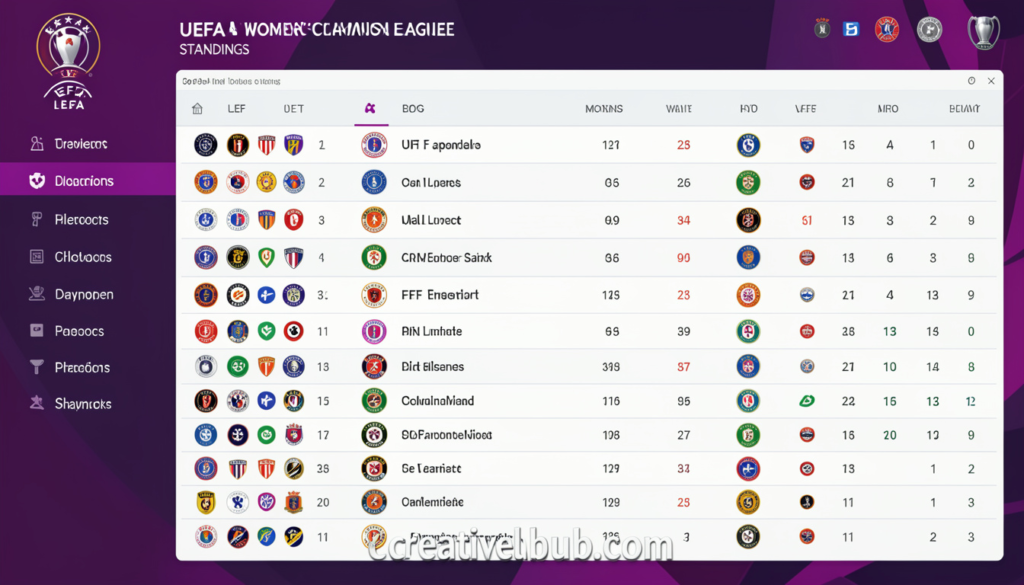
Under the old system, you could finish top of a weak group and still face an easier path forward. The new single-table format fixes that. The standings reflect true performance across a broader range of opponents. Every point counts from matchday one.
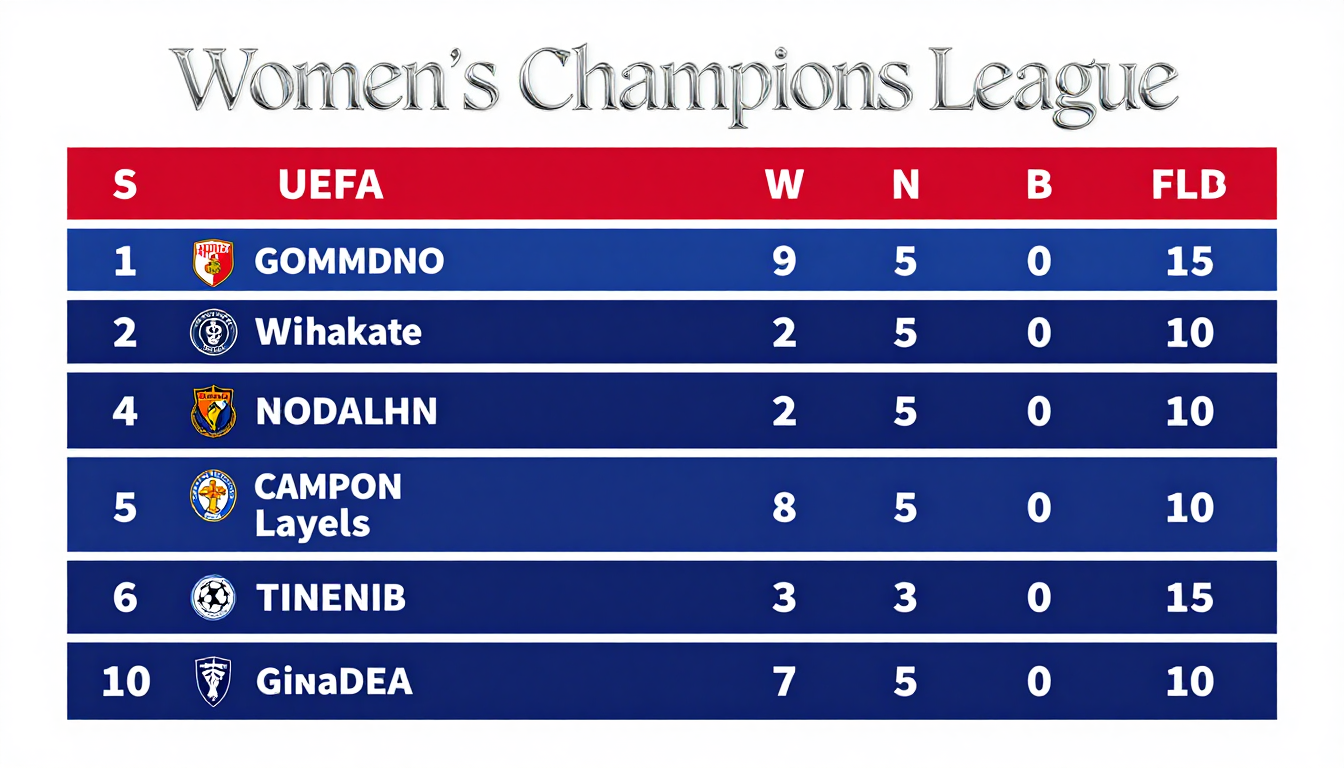
The top four teams in the league phase standings skip straight to the quarter-finals. Teams ranked fifth to twelfth enter knockout play-off rounds. Teams ranked thirteenth to eighteenth are eliminated entirely.
How the 2025/26 League Phase Standings Worked
The league phase ran from 7 October 2025 to 17 December 2025. Eighteen of Europe’s best women’s clubs competed across six matchdays.
Teams were split into three pots based on UEFA club coefficients. Each team then faced two opponents from each pot: one at home, one away. This seeding structure guaranteed a balanced mix of tough and moderate opponents for everyone.
The Top Four Who Earned Automatic Quarter-Final Spots
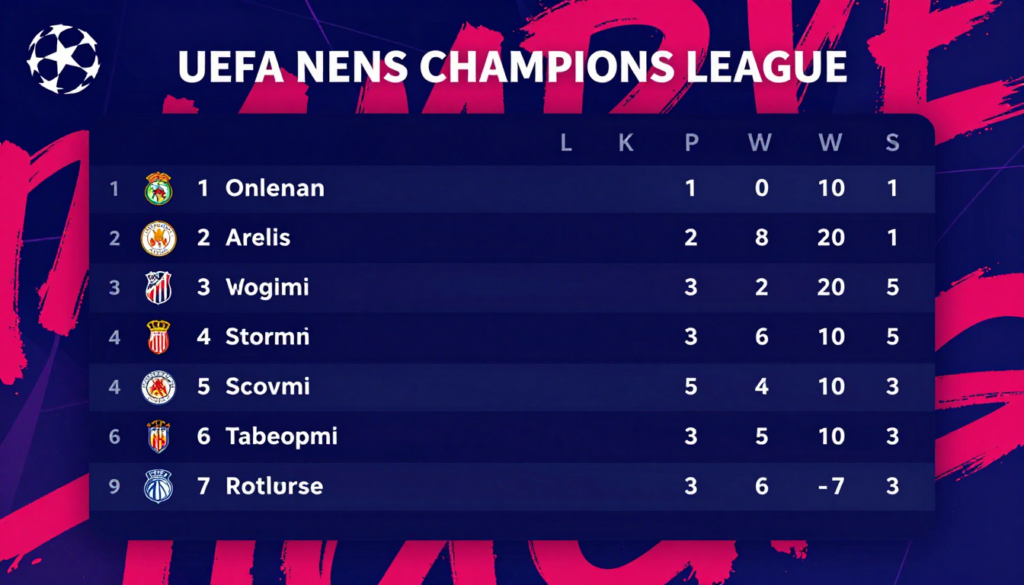
Barcelona finished at the very top of the league phase standings. They were outstanding from start to finish, racking up 16 points and boasting the best goal difference in the competition. They conceded just five goals across the entire league phase, the fewest of any team.
OL Lyonnes joined Barcelona in the top four, also finishing on 16 points but behind on goal difference. Lyon showed the kind of efficiency and experience you expect from a club that has won this competition eight times.
Arsenal, the reigning champions and title holders, also secured a top-four finish. The Gunners entered as defending champions after their famous 1-0 win over Barcelona in the 2024/25 final in Lisbon. They proved they belonged at the top of the table again.
Bayern München rounded out the top four. The German giants had an almost flawless domestic campaign too, clinching their fourth consecutive Bundesliga title during the same period.
Teams That Entered the Knockout Play-Offs
Teams finishing fifth through twelfth entered the knockout play-off round in February 2026. Notable names in this bracket included Chelsea, Manchester United, Real Madrid, and Paris FC, among others.
Chelsea, for example, advanced through the play-offs and set up a thrilling all-London quarter-final against Arsenal. Real Madrid also came through, setting up a Women’s Clásico against Barcelona in the last eight.
Teams Eliminated After the League Phase
Teams ranked thirteenth to eighteenth were knocked out after the league phase. This included clubs like Atlético de Madrid, Vålerenga, and St. Pölten, who could not accumulate enough points in the unified standings to survive.
The Knockout Phase: Drama at Every Turn
Once the league phase standings settled the bracket, the real drama began.
Quarter-Final Highlights
The quarter-finals delivered some of the most compelling football of the 2025/26 season.
Arsenal vs Chelsea was the headline tie. Two London clubs, two fierce rivals, and a pulsating two-legged battle. Arsenal edged it 3-2 on aggregate, with Alessia Russo playing a key role throughout. It was a genuine English derby at the highest European level.
Barcelona vs Real Madrid was another standout. The Women’s Clásico turned into a one-sided affair. Barcelona dismantled Real Madrid 12-2 on aggregate, including a stunning 6-0 win in the second leg. That scoreline tells you everything about Barcelona’s attacking quality this season.
Bayern München vs Manchester United saw the German side progress 5-3 on aggregate. Bayern were clinical and composed, punishing United’s defensive mistakes when it mattered most.
OL Lyonnes vs Wolfsburg went the distance. Lyon needed extra time in the second leg to finally put Wolfsburg away, winning 4-1 on aggregate. It was not pretty, but Lyon’s experience and quality eventually told.
Semi-Final Stories
The semi-finals brought the biggest matchups of the season.
Barcelona vs Bayern München began with a tense 1-1 draw in Munich. Ewa Pajor gave Barcelona an early lead, but Franziska Kett equalized before being sent off. That red card shifted momentum heading into the second leg at Camp Nou. Barcelona then delivered a masterclass, winning 4-2 on the night for a 5-3 aggregate victory. Alexia Putellas scored twice, Ewa Pajor added her ninth of the campaign, and the Catalan side booked their place in a sixth consecutive Women’s Champions League final.
Arsenal vs OL Lyonnes was pure drama from start to finish. The sides had met in the same stage the season before, with Arsenal winning that time. This time, Lyon flipped the script. After a closely fought first leg, Lyon came from behind in the return. Wendie Renard equalized from the penalty spot, Kadidiatou Diani edged the hosts ahead, and Alessia Russo nearly forced extra time with a close-range finish in the 76th minute. Then came the moment of the tournament. Jule Brand controlled a chipped ball from Melchie Dumornay and slotted in with her left foot in the dying minutes to send Lyon to the final. It was the kind of goal that gets replayed for years.
The 2026 Final: Barcelona vs OL Lyonnes in Oslo
The 2025/26 UEFA Women’s Champions League final will take place on 23 May 2026 at Ullevaal Stadion in Oslo, Norway.
This is a final that writes its own story before a ball is kicked.
Barcelona are chasing their fourth Women’s Champions League title. They have won it in 2021, 2023, and 2024, losing only last season’s final 1-0 to Arsenal. A win in Oslo would make them the most successful club in the competition over the past five years.
OL Lyonnes are the most decorated club in Women’s Champions League history with eight titles. This is their twelfth final. Stars like Wendie Renard and Ada Hegerberg will carry massive expectations. For Hegerberg in particular, the final being played in her home country of Norway makes it a deeply personal occasion. The all-time leading scorer in Women’s Champions League history, she has already scored three times in this campaign and won four finals in the past.
Players to Watch in the Final
Here are the key names you should watch in Oslo:
- Ewa Pajor (Barcelona): The Polish forward leads the season’s top scorer rankings with nine goals. She joined from Wolfsburg two summers ago and has been unstoppable.
- Alexia Putellas (Barcelona): Two-time Ballon d’Or winner. Seven goals and seven assists this campaign. Still the heartbeat of Barcelona’s attack.
- Ada Hegerberg (OL Lyonnes): Eight-time Women’s Champions League winner. Three goals this season. Playing the final in Norway. The narrative writes itself.
- Melchie Dumornay (OL Lyonnes): Won four Player of the Match awards this campaign. Her assist for Brand’s semi-final winner was the highlight of the knockout stage.
- Wendie Renard (OL Lyonnes): Captain. 35 years old. Part of all 11 of Lyon’s previous finals. A legend of the game in every sense.
A Quick Look at the Competition’s History
Understanding the standings and current form is even more meaningful when you know the competition’s background.
The UEFA Women’s Champions League started in 2001 as the UEFA Women’s Cup. It was renamed and reformatted in 2009. Since then, the competition has grown into the premier club event for women’s football in Europe.
OL Lyonnes dominate the record books with eight titles. Barcelona have three. Wolfsburg have two. No other club has won it more than once in the UEFA Women’s Champions League era, though Frankfurt won the inaugural UEFA Women’s Cup in 2002.
In the 2024/25 season, Arsenal became English champions of Europe for the first time, defeating Barcelona 1-0 in Lisbon. That victory made Arsenal the fourth different winner in four seasons, showcasing just how competitive the competition has become.
The 2025/26 season’s new format only amplifies that competitive spirit further.
Why the New Standings Format Makes Women’s Football Better
I genuinely think the new format is one of the best things to happen to women’s club football in years.
Under the old group stage model, weaker groups could produce distorted results. A team could go unbeaten in a soft group and still lack the battle-hardening needed for the knockout rounds. The single-table standings fix that problem entirely.
Every matchday now carries genuine stakes. A draw on matchday two might cost you a top-four finish. A heavy defeat might not eliminate you, but it will hurt your goal difference and potentially your position in the bracket. These are decisions and pressure points that improve the quality of football and the tactical depth of the competition.
It also means fans following the UEFA Women’s Champions League standings see a clearer, more exciting picture week to week. You can track exactly where your team stands and what they need to do to advance. That transparency makes the competition more engaging for everyone.
Conclusion
The UEFA Women’s Champions League standings in 2025/26 told a story of excellence, drama, and evolution. Barcelona’s dominance at the top of the league phase, Lyon’s characteristic resilience, Arsenal’s hunger as defending champions, and Bayern’s relentless progression all made for a season to remember.
The new single-table format proved itself immediately. It delivered clearer standings, more meaningful matches, and better football throughout the league phase.
As we head into the Oslo final between Barcelona and OL Lyonnes on 23 May 2026, the biggest question in women’s club football is ready to be answered. Will Barcelona claim their fourth title? Or will Lyon add a ninth star to their remarkable trophy cabinet?
Which team are you backing in Oslo? Let us know in the comments, and share this guide with anyone who wants to understand the Women’s Champions League standings before the final whistle blows.
Frequently Asked Questions
1. How do the UEFA Women’s Champions League standings work in 2025/26? All 18 teams in the league phase compete in one unified table. Each team plays six matches. Teams earn 3 points for a win, 1 for a draw, and 0 for a loss. The top four advance directly to the quarter-finals. Teams ranked 5th to 12th enter knockout play-offs. Teams 13th to 18th are eliminated.
2. Who topped the UEFA Women’s Champions League standings in 2025/26? Barcelona finished top of the league phase standings with 16 points and the best goal difference. OL Lyonnes also finished on 16 points but were second on goal difference.
3. What is the new format of the UEFA Women’s Champions League? From 2025/26, the old four-group format was replaced by an 18-team single league phase. Every team plays six different opponents using the Swiss system model, three at home and three away, before the knockout rounds begin.
4. Who are the defending champions of the UEFA Women’s Champions League? Arsenal are the current title holders. They defeated Barcelona 1-0 in the 2024/25 final held in Lisbon, Portugal.
5. Who is the most successful club in Women’s Champions League history? OL Lyonnes hold the record with eight Women’s Champions League titles. They are competing in their twelfth final in Oslo in May 2026.
6. Who leads the top scorers chart in the 2025/26 Women’s Champions League? Ewa Pajor of Barcelona and Alessia Russo of Arsenal were the joint top scorers going into the final stages of the competition, each with nine and eight goals respectively.
7. Where is the 2026 UEFA Women’s Champions League final being held? The final takes place at Ullevaal Stadion in Oslo, Norway, on Saturday 23 May 2026 at 18:00 CET.
8. How many teams compete in the UEFA Women’s Champions League? In total, 18 teams compete in the league phase. Before that, qualifying rounds involve a much larger number of clubs from across UEFA’s 55 member associations.
9. When does the UEFA Women’s Champions League usually start and end? The qualifying rounds begin in July. The league phase runs from October to December. The knockout stage carries the competition through to May, when the final is played.
10. Can I watch the UEFA Women’s Champions League online? Yes. Disney+ is the main broadcast platform for Women’s Champions League matches across much of Europe. Availability may differ depending on your region.
also read: creativelabhub.com
email: johanharwen@314gmail.com
Author Name: Jamie Hartley
About the Author : Jamie Hartley is a sports journalist and women’s football analyst with over eight years of experience covering European club competitions. Jamie has followed the UEFA Women’s Champions League since its rebranding in 2009 and writes regularly about tactics, player development, and the growth of the women’s game across Europe. When not writing, Jamie can be found watching lower-league women’s football or arguing passionately about which era of OL Lyonnes was the greatest.